Induced Voltage
A magnetic field that changes over time always induces a voltage in a coil. A constant magnetic field does not. This comes from physics. I do not want to go into the causes here; that would need a separate lecture.
To explain the induced voltage, we first set all coil currents to 0A. The electromagnets then generate no magnetic fields; only the rotor has a magnetic field. We rotate the rotor continuously. This happens in a power plant in which, for example, a wind turbine turns the axis of the rotor. The wind turbine is generally turned mechanically (by the wind).
Induced voltage due to the permanent magnet
The magnetic flux of the permanent magnet is constant at the magnet itself. But the magnet moves past the coils in a circle. In doing so, its distance from the coils changes. The coils do not change their position, but the rotor does. The rotor – and with it the magnetic field – moves past the coils. The amount of magnetic field that penetrates a coil therefore changes sinusoidally over one revolution of the rotor. The phase of the sine wave depends on the position of the coil around the rotor.
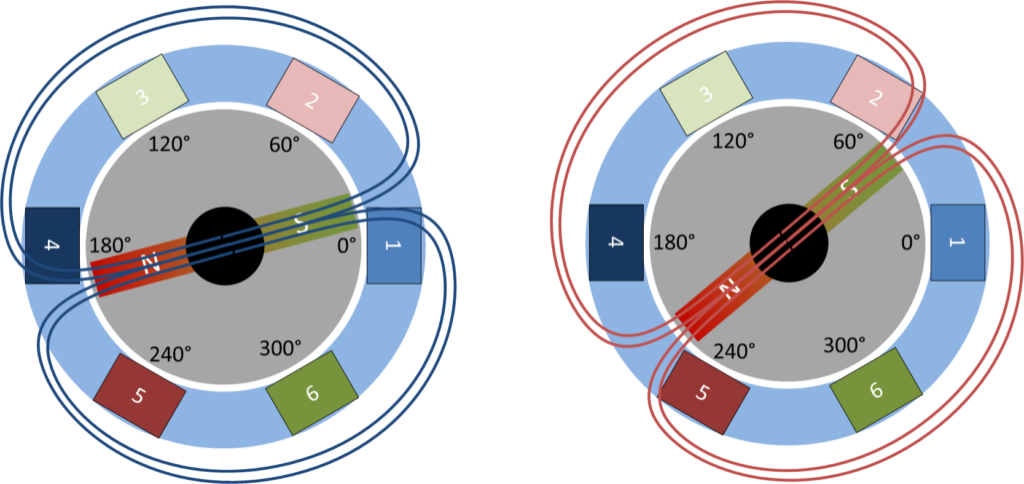
The light blue regions between the coils are – just like the coils – magnetically conductive. Part of the field always flows through the coils. The figure above makes it clear that, depending on the rotor position, different amounts of magnetic field are present in the coils. In the left rotor position, most of the field passes through the two blue coils. The field through the two red coils is much smaller. That is why the field lines are drawn in blue. Almost no field passes through the two green coils. If the rotor turns further, as in the right figure, more field passes through the red coils than through the blue coils. Here the field lines are drawn in red.
The magnetic field changes over time. It induces a voltage in the coils of the stator. The induced voltage is proportional to the time derivative of the magnetic flux. Because the magnetic flux is sinusoidal, the time derivative becomes a multiplication by the term jω through the Laplace transform.
For permanent magnets, instead of the magnetic flux φ we use the flux linkage Ψ. So a permanent magnet has a “magnet strength” ΨPM. For a coil, Ψ = n ∙ φ = L ∙ I applies. This makes our magnetic field quantities and symbols compatible with the literature. It changes nothing for understanding. You do not need to understand the meaning of the magnetic field quantities; they are simply a measure of its intensity. The following applies:
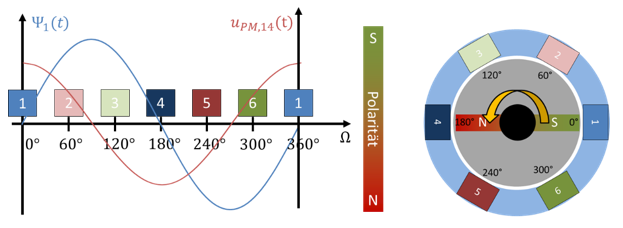
The voltage leads the magnetic field in the direction of rotation by j, i.e. by 90°. The figure above shows the magnetic field induced in coil 1. It leads to a voltage across coils 1 and 4, drawn as uPM,14.
If the rotor turns faster, the magnetic field in the coils changes faster. This increases the intensity of the induced voltage, because the slope of a sine wave increases with the sine frequency. That is also intuitively why the angular frequency ω appears as a factor in the formula for the induced voltage.
The permanent magnet has a magnetic field of constant strength. It induces a voltage that depends only on the speed of the rotor or the electrical angular frequency ω. This voltage is present at all three coil pairs, shifted in time (i.e. phase-shifted).
Induced voltage due to the coils
In the same way, a voltage is induced in the coils when current flows through the coils. Then the magnetic fields of the coils are superimposed on that of the permanent magnet on the rotor. The rotor field itself, however, remains unchanged. The magnetic field of the coil induces the following voltage:
We obtain the voltage from the component equation of the inductor in the frequency domain. Since the coil current, and with it the coil magnetic field, changes with the angular frequency ω, the induced voltage is also sinusoidal.
Total induced voltage
In operation, the rotor turns and current flows through the coils at the same time. The magnetic fields of the rotor and those of the coils therefore add up to a total field. In total, the following voltage is induced: