Active and Reactive Power
In this subchapter, I try to explain active and reactive power intuitively. For this, I use a mechanical movement as an analogy. The goal is: a metal ball of mass m is moved from place A to place B. This requires a velocity v. From velocity and mass, we can calculate the kinetic energy. The following applies:
Unfortunately, the ball hangs on a thread. We can only move the upper mounting of the thread. The mounting sits on a carriage on a rail along which the mounting can be moved in one direction. The ball then follows the movement. The setup looks like this:
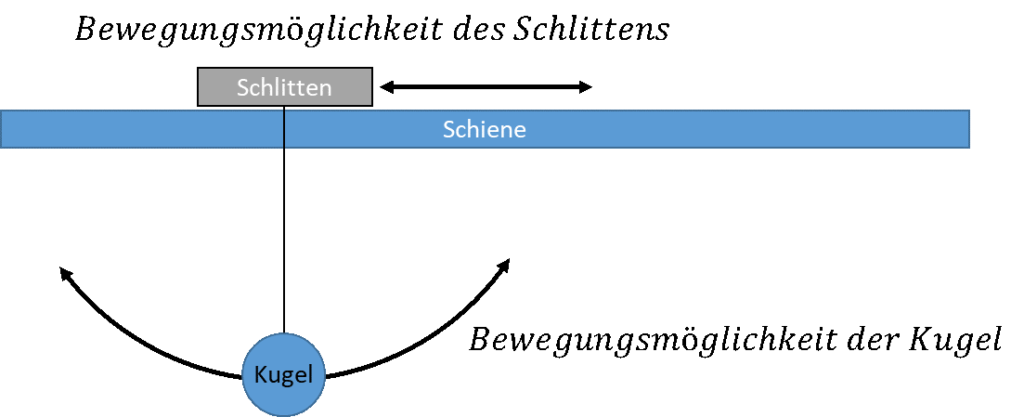
Because the ball hangs on a thread, it can swing back and forth like a swing. We assume that the swinging is ideal and without friction. There are two possible movements: the unwanted swinging of the ball and the desired linear movement of the ball along the rail. Both are movements, but they have different effects.
Reactive power
Reactive power moves energy from one store to another store. No energy is released to the outside. The energy circulates within the system. The two forms of energy of the pendulum oscillation are “kinetic energy” and “potential energy”. When the ball is at the turning point of the movement, the potential energy is at its maximum and the kinetic energy is 0. At the lowest point, the kinetic energy is at its maximum and the potential energy is at its minimum.
During the movement, energy is constantly converted from one form into the other. Every change of energy requires power. This change of energy only requires reactive power. No energy passes to the outside. The system does not cause anything to the outside, and there is no effect from outside on the system.
Reactive power moves energy between two stores. The stores of the pendulum are its height and its velocity. These stores are not easy to understand; I will not explain them here.
Active power
Deflecting the pendulum from its rest position requires energy from outside. So active power is needed to start the pendulum. The energy within the system is increased. When the pendulum is slowed down (e.g. by friction), it warms the surroundings and its movement becomes weaker. This also requires active power, because the warming is a change that acts from the system to the outside. Active power always has a direction: into the system or out of the system.
The linear movement along the rail requires energy from outside. You can tell this from the fact that the carriage stands still without an external supply of energy. Through active power, the pendulum changes its position permanently. Reactive power causes a movement that is only temporary.
Whether a power is reactive power or active power can be recognised, among other things, by whether energy is or has to be supplied from outside for a change of state. The pendulum keeps swinging without energy having to be supplied from outside. So the swinging only requires reactive power. Only starting it requires active power; for this, energy must be supplied from outside.
Reactive power is generally not problematic, because it often does no harm. If the swinging of the pendulum does not disturb the application, then let it swing. No electrical energy has to be used for this. Many applications require that a system does not oscillate. Then you should avoid reactive power.
Apparent power
It is possible that the pendulum swings and is moved linearly at the same time. Then it requires active and reactive power at the same time. Systems with energy stores generally have a mixture of active and reactive power. Together, the two powers give the apparent power. Active and reactive power are added as complex numbers. More on this later.
In electrical systems with pure reactive power, voltage and current are shifted by ±90° or ±π/2 relative to each other.
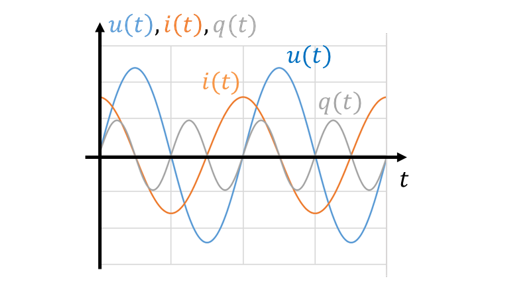
In the example above, the current leads the voltage by 90°. This is always the case with a capacitor. Electrical power is defined as the product of u and i. Like the pendulum, the power oscillates around 0. It is pure reactive power, which is why it is called q(t) here. Calculating the power in the time domain shows that the power oscillates at twice the frequency and that its curve is sinusoidal.
Let us now look at pure active power. Voltage and current are not shifted relative to each other; they are “in phase”.
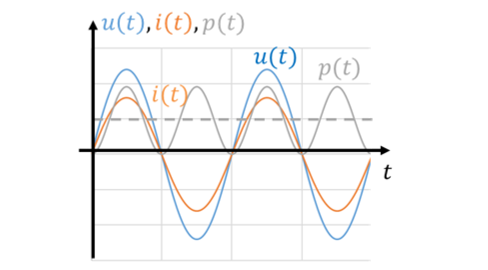
The power is always positive. The formula also shows this: the term 1 − cos(2ωt) has a range of values of [0 … 2]. This range is then multiplied by the factor in front. A sine has a range of values of [−1 … 1].
The behaviour corresponds to a pendulum that is always moved in one direction by the carriage. The power oscillates between 0 and the positive peak value. Explaining this goes beyond the pendulum analogy. It is enough here to see that the power does not oscillate around 0, but always points in one direction. This is 100 % active power.
Charging and discharging energy stores
Charging a store from a source and discharging a store into a load require active power. This is like the initial push of the pendulum out of its rest position. Discharging into another store and charging from another store require reactive power. In AC circuits with inductors and capacitors in the steady state, there is always reactive power. If you simulate such a circuit, you will find that voltages and currents at the start of the simulation behave somewhat differently than in the steady state. This is because the stores are charged at the beginning (with active power). The pendulum is pushed at the start. Only then does the pendulum swing permanently.
The charging and discharging processes of stores via resistors from the chapter Charging a store therefore require active power. The power as the product of voltage and current is shown for a charging process in the figure below:
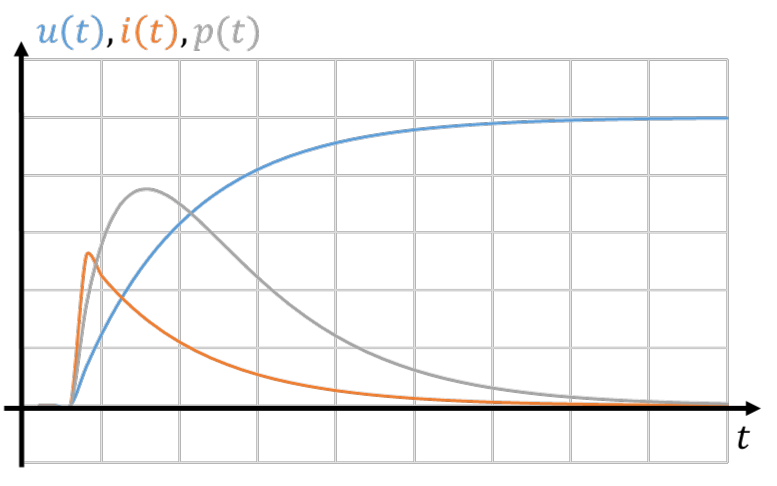
The power is always positive; it points in one direction. So it is active power.