Electric Current
Let us look again at the example of charge separation from the chapter Charge. If a path that electrons can travel is opened between the two bodies with the separated charges, an exchange of charge takes place due to the voltage (and thus the force on the electron).
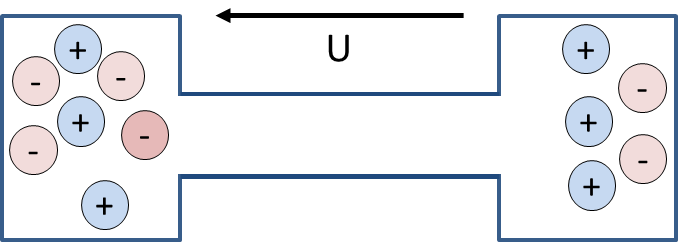
The electron moves from the left-hand body back to the right-hand body, just as the stone falls to the floor. The movement of electrons is called electric current i. The more electrons move per unit of time, the greater the current. The mathematical relationship between current i and the movement of charge is:
| Physical quantity | Symbol | Unit name | Unit symbol |
|---|---|---|---|
| Electric current | \(i\) | ampere | \(\mathrm{A}\) |
The electric current i is given in the SI unit ampere (A).
A note on notation: above, I used the lower-case letter i for the current. We always use lower-case letters for quantities that vary over time. Upper-case letters indicate that the quantity is constant over time. So a constant current gets the symbol I. The same applies to voltages, charges, powers, etc.
Current has an effect in an electrical load. If current flows through an LED, for example, it makes it light up. If it flows through a motor, it makes it turn. To achieve an effect, we have to let the current flow through a load in a targeted way. To do this, the electrons are offered a path for charge balancing that leads through the respective load.
The chain of effects in electrical engineering
To achieve something in electrical engineering, charge must first be separated. This creates different potentials. Between locations of different potential, a voltage arises as the potential difference. The charges are then offered a path for charge balancing that leads through the load. The movement of electrons is called current. The current has an effect in the load.
Providing separated charges in practice
Charge separation usually takes place in a power plant. In coal-fired power plants, coal is burned and steam is generated, which flows through a turbine. This makes the turbine rotate. The turbine is connected via a shaft to a generator, whose rotor also turns. In the generator, the rotary motion is converted into the electrical quantities voltage and current. In this process, thermal energy released by burning coal is converted into kinetic energy of the steam. This is converted in the turbine into kinetic energy of the rotary motion. The generator converts the kinetic energy into electrical energy.
In a wind turbine, the wind turns the blades and thus the shaft attached to them. The generator, which produces voltage and current, is mounted on the shaft. Voltage and current reach the sockets from the power plant via cables and are available to us there. The kinetic energy of the wind is converted into electrical energy in the generator.
Other types of power plant, such as hydroelectric or biomass plants, use other mechanisms to turn the generator shaft; otherwise they work in exactly the same way. When the battery of a smartphone is charged, the separated charge available at the socket is – greatly simplified – diverted into the chambers of the battery.
A simple circuit
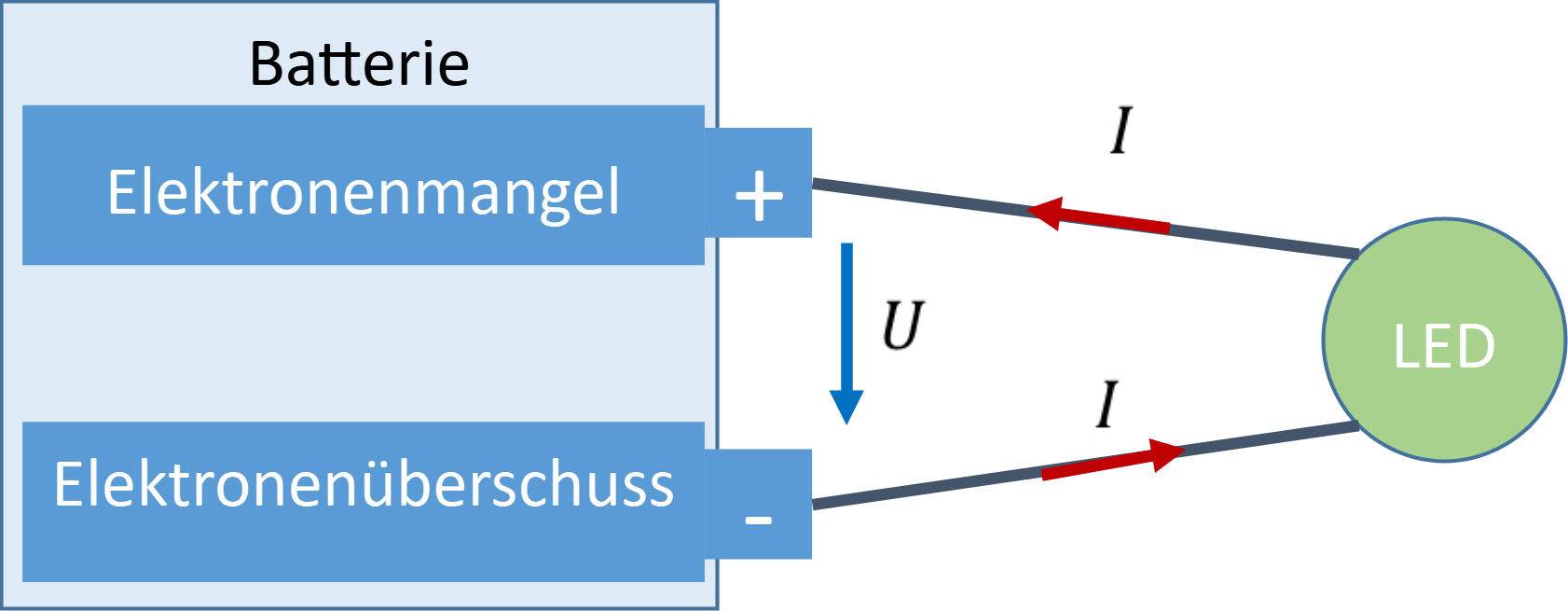
Usually we do not separate the charge just before we need it to operate loads. We use stores for separated charges, such as batteries. Simply put, a battery contains two separate chambers. One has a deficiency of electrons (+), the other an excess of electrons (−). In a torch, a battery is connected to an LED via cables.
The electrons from the chamber with the excess of electrons flow in the direction of the red arrows through the cables and through the LED into the chamber with the deficiency of electrons. This movement of electrons makes the LED light up. This continues until the battery is empty. Then complete charge balancing has taken place between the two chambers. The switch of the torch interrupts the path for the electrons between the two chambers, so that the LED only lights up when needed.
Conventional current direction
In electrical engineering there is a sign problem between the directions of voltage and current. A voltage is positive if it (or the arrow representing the voltage) points from the positive potential with a deficiency of electrons to the negative potential with an excess of electrons. However, the flow of negatively charged electrons is from the negative potential to the positive potential. In metals, it is always the negatively charged electrons that move, because the positive protons are fixed in place. This is roughly as if a stone fell from the floor to the ceiling. This direction of current flow is called the "physical current direction" (electron flow).
To solve this problem, the sign of the current is reversed by convention in electrical engineering. So that the intuitive description of the movement of charges continues to work, it is specified that there are only positive charge carriers. Mentally, we thus move away from electrons and protons, because the new kind of description helps better with the following problems.
Instead, there are only positive charges and thus only positive potentials. This also brings us closer to the analogy of height above the centre of the Earth, which is also always positive. At a high positive potential there are many (positive) charges, at a lower potential there are few (positive) charges. But since we place the zero point for the potentials wherever it suits us anyway, there are still negative potentials relative to the zero point. The height of the basement is still negative for us if we refer it to the height of the floor, even though the basement has a positive height relative to the centre of the Earth.
The voltage between the potentials can still be positive or negative, depending on how the direction is defined. So nothing changes for the voltages. However, the current of positive charges now flows from the higher potential to the lower potential; in the thought model, the stone falls down again. This direction of current is called the conventional current direction.
From the point of view of physics, this change in modelling the behaviour of charges is of course wrong. However, since the new modelling brings many advantages and, above all, a mathematical simplification for calculating and describing electrical problems and solutions, it is used worldwide.
With the conventional current direction, the example of the torch looks like this:
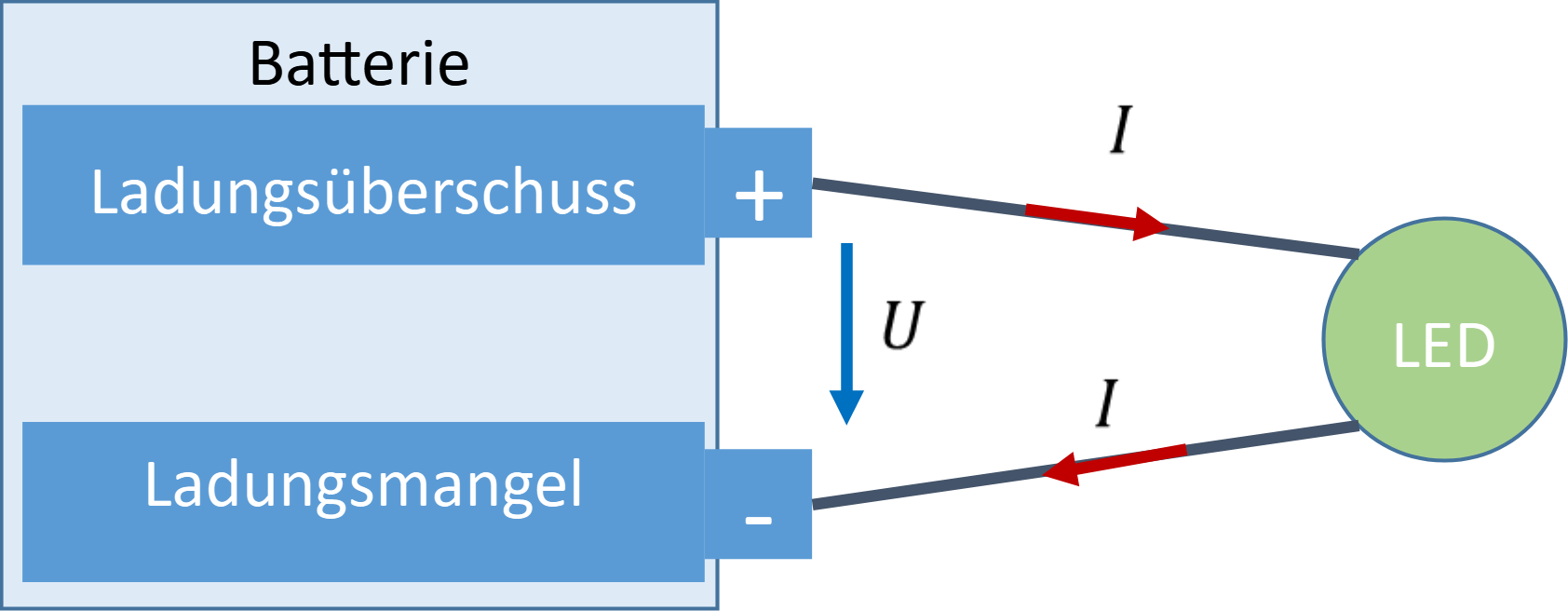
From now on, the following changes to the previous physical description therefore apply in this text:
- All mobile charges are positive
- All potentials are positive
- The current flows from the higher potential (+) to the lower potential (−)
Current density
Not just any amount of current can flow through a conductor. The current heats the conductor. If it heats up too much, the conductor is damaged or even destroyed. For this reason, very thick conductors (with a large cross-sectional area) are used for overhead power lines, for example. When charging a smartphone, much less current flows, so a thinner cable is sufficient here. Since the magnitude of the current is related to the cable cross-section when designing a conductor, a new quantity is introduced that is helpful for this calculation: current density. The current density J divides the current by the area through which the current flows. The following applies:

| Physical quantity | Symbol | Unit |
|---|---|---|
| Current density | \(J\) | \(\mathrm{A}/\mathrm{m}^2\) |
Current in cables
When building circuits in which current flows, the components of the circuit are often connected with cables. For simplicity, the necessary cable thickness can be taken from tables (e.g. DIN VDE 0298-4; 2003-08 table 11).
Common cables consist of a copper wire and an insulating sheath, which ensures that the current only flows through the cable and cannot – if the cable touches a body – flow into that body. The copper wire conducts current well, the sheath not at all.
Further information (in German)
Frustfrei Lernen: current
Frustfrei Lernen: charge
YouTube video