Measuring Resistors
Many physical quantities act on ohmic resistors. That is why this chapter discusses how a change in resistance can be converted into a change in voltage. For this, we consider a PT100 resistor with the following characteristic of resistance value versus temperature:
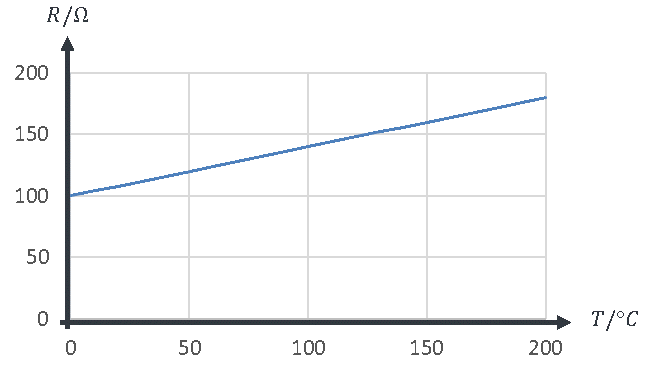
The characteristic is slightly non-linear. This can hardly be seen in the graph. Around the value T = 0 °C, it can be linearised by an approximation:
At a temperature of T = 0 °C, the sensor has the resistance RPT100 = 100 Ω. This point gives the sensor its name. As the temperature increases, the resistance value rises almost linearly. We can split the resistance value into a fixed resistance value and a temperature-dependent variable resistance value:
Splitting a measuring resistor into an unchanging part R and a part ΔR that depends on the physical quantity is very important for the following chapters. In the example above, the unchanging part is R = 100 Ω and the variable part is ΔR = 0.4 Ω/°C · T. To practise this split, here is another example of an (imaginary) pressure sensor:
A change in resistance cannot be converted into a digital number, i.e. it cannot be digitised. Only voltages can be digitised. Digitising currents and times is so rare that I do not cover it here. That is why the resistance value of the sensor must be converted into a voltage value. Three ways of doing this are compared. You are to learn how solutions can be evaluated against criteria.
The following criteria are applied:
1. The characteristic should be as proportional as possible.
2. The implementation effort should be low.
3. The highest possible sensitivity should be achieved. The voltage should change as much as possible even with a small change in temperature.
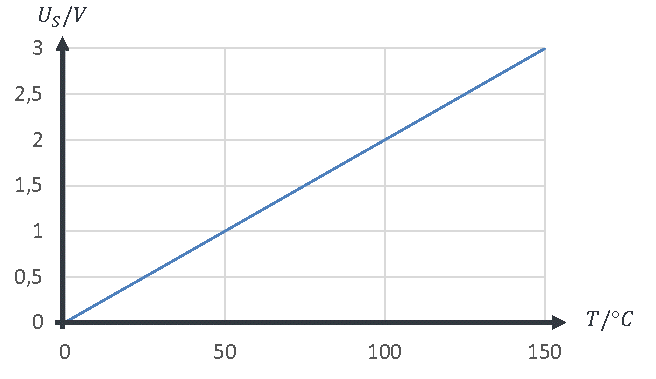
What we want to achieve as the ideal looks like this graphically: