AC with Storage Elements
Integration and differentiation
When we calculate with energy stores, we have to integrate or differentiate. How does this work with sinusoidal quantities? For an arbitrary constant a, the following applies:
When integrating and differentiating, a sine turns into a cosine and vice versa. This is not a problem for us, because sine and cosine only differ in that they are shifted by 90° relative to each other. The following applies:
Considering the phase at an energy store leads to very complex mathematics. Reducing the problem to the peak values can be described with simple mathematics. That is why, from now on, only the peak value is considered for the BMT degree programme. If you are interested in the complex mathematics, look at the electrical engineering course for ETR. It takes many hours to read up on it – but it is interesting.
If we do not care about the phase shift, i.e. we only consider peak values, we can treat sine and cosine almost the same.
The peak values of both voltages are equal.
Adding sine and cosine
What happens if we add the two voltages? One might expect a peak value of 10 V when two alternating voltages with a peak value of 5 V each are added. However, the graph of the two functions shows that it is not that simple. The sum voltage uS is calculated as follows:
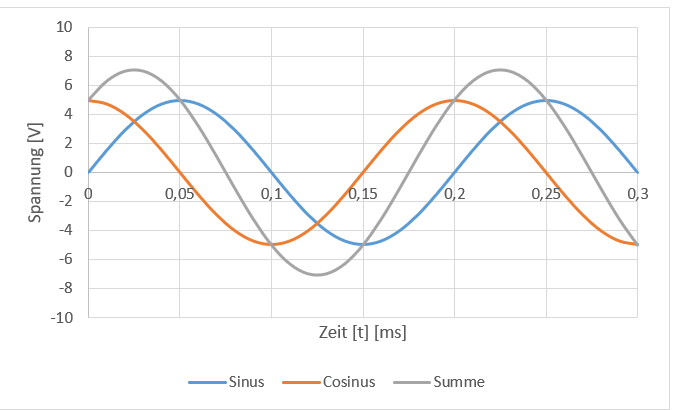
The voltage u1 is shown in blue. It is sinusoidal. The cosine-shaped voltage u2 is shown in red. The sum of the two voltages u1 + u2 is shown in grey. The peak value of the sum is not the expected 10 V, but just over 7 V. This is because the two maxima do not occur at the same time, so 5 V + 5 V is never reached.
We can derive the calculation from the unit circle. The length of the black arrow is 1. It points to the circumference of the circle with radius 1. In the right-angled triangle formed by the black, blue and red arrows, we can calculate with Pythagoras and with the legs of the triangle.
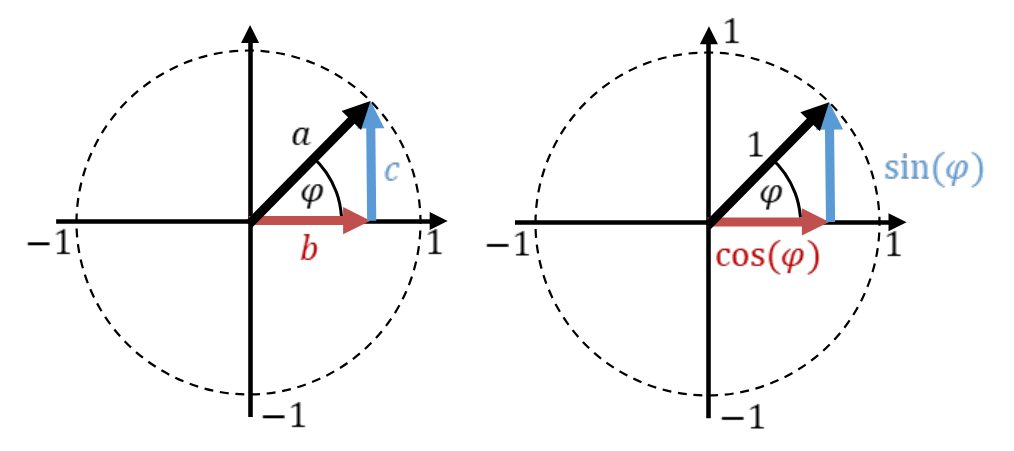
In the triangle, sine and cosine are not simply added; they are added in quadrature. We use this to calculate the peak value for sine and cosine:
We can calculate the peak value, but not the phase of the sum voltage. As shown once more in the figure below, the sum voltage is shifted relative to the sine and the cosine. This shift angle cannot be determined with the simplified calculation method. The result for the sum voltage can now be written as follows:
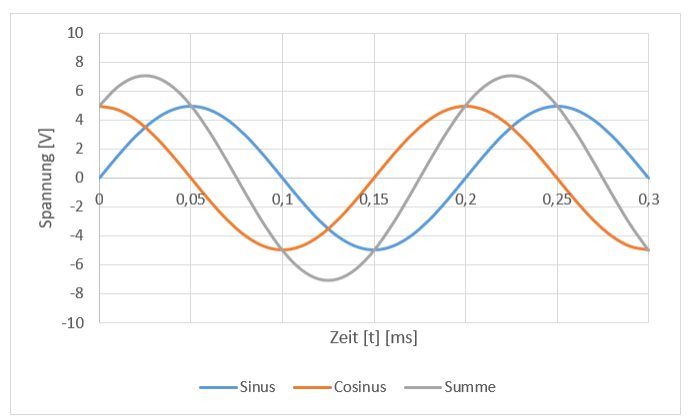
In this course, you only learn to calculate the peak values. The phases are not relevant for the exam. The phase in the example above would be different if the peak values had not happened to be chosen equal. We will not go into this further here; you should just know that the phase is not always π/4.
Remember: when calculating the peak value of a sum of two voltages, you must check whether sine or cosine functions are present. If two sine voltages are added, the peak values are simply added. If a sine is added to a cosine, the peak values are added in quadrature.
Examples
If 2 sine functions are added, the peak values are added “normally”.
If a sine is added to a cosine, they must be added “in quadrature”.