Guiding the Field
Magnetic fields can be guided. This works in a similar way to electric current. Suppose we separate charge in a battery to which nothing is connected. The separated charge strives to equalise. But only when an electrically conductive path has been created for the charge equalisation does current flow. The current flows along the conductive path, i.e. it is guided. This is, for example, a cable leading from the battery to the load. No current flows alongside the cable, because air has such a low conductivity for current.
The magnetic flux also “flows” through air. The magnetic conductivity of air is low, but much higher than the electrical conductivity of air. In the analogy, this is as if current also flowed through air. Then a small current would flow between the electrical contacts of every socket.
When current flows through a conductor surrounded by air, the magnetic field strength first forms around the conductor. Then there is a relatively small magnetic flux along the field lines of the magnetic field. If we place material with higher magnetic conductivity around the wire, the magnitude of the magnetic flux density is greater. For a conductor:
Independently of the material, the magnetic field strength H depends only on the current and the distance r. The magnetic flux density B increases with the material coefficient µr. For the B field it makes no difference whether we invest more current I or use magnetically more conductive material with a higher µr. For the drive, however, it makes a decisive difference. The required current can be reduced massively if material with a high µr is used. This is advantageous because U and I at the drive should be manageable quantities.
We place magnetisable material with a high µr around the conductor in the form of a toroidal core (blue ring in the figure below). Then almost the entire field “flows” inside the core and almost nothing in the surrounding air any more. This is like a parallel circuit in electrical engineering. There is a low-resistance path and a high-resistance path. Where does the current flow? The magnetic flux can flow either through air or through the material with high µr. At µr = 100000, almost nothing flows through air any more.
In the example below, a magnetic core (blue) is placed around a current-carrying conductor. The magnetic field around the conductor flows almost exclusively in the magnetic core.
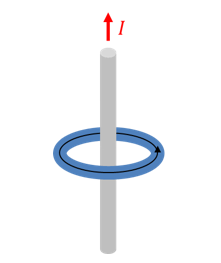
This effect is called “field concentration” or “field guidance”. It means that the field no longer exists freely in space but only in a specified region. The greater µr, the greater the share of the guided field in the total field.