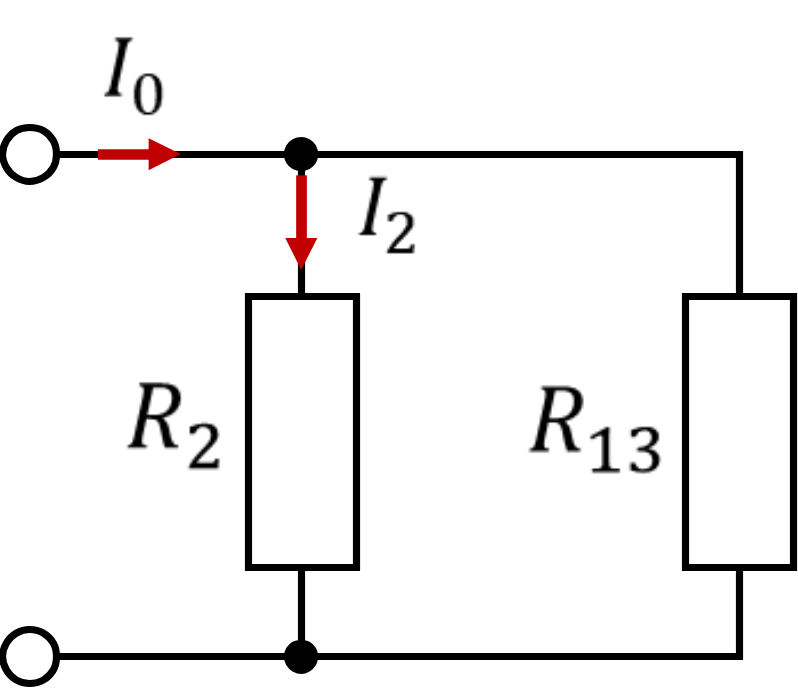
Current Divider
A current divider is used to split a current in a parallel connection in a targeted way. Conversely, the current divider can be used to calculate how a current splits in a parallel connection. Like the voltage divider, the current divider is defined for the special case of two resistors. If the values of the two resistors change, the division of the current changes.
If two resistors R1 and R2 are connected in parallel, the following applies:
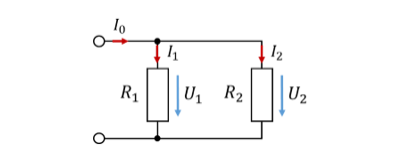
We call the two bottom formulas the current divider formulas. They can be used to calculate a partial current without having to know any voltage in the network. We only need the current flowing into the parallel connection. In addition, we need the values of the two resistors.
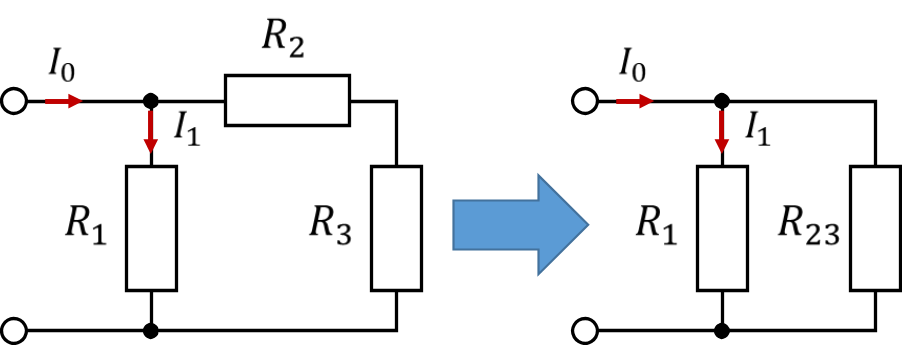
These formulas only apply exactly to the circuit drawn. If the parallel connection is not in this form, it must first be brought into this form by combining resistors. If, for example, the partial current through R1 in the following circuit is to be calculated with the current divider, R2 and R3 must first be combined into R23 (series connection).
In the current divider, the denominator always contains the sum of the resistances. The numerator contains the resistance through which the current does not flow – i.e. the other resistor.
Problem: Calculate the current I2 in the following network:
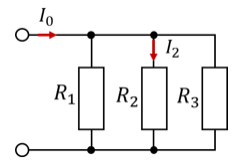
Intuitive solution: the current divides equally among the three equal resistors. So 1/3 of the current I0 flows in the middle branch. Thus I2 = 2 A. For the computational solution, the resistors R1 and R3, which are connected in parallel, must first be combined. The following applies:
The simplified circuit now has the standard form for the current divider.