Oscillation Waveform
If a damped system is left at rest, the oscillation never starts by itself. An oscillation must be started with energy from outside. So that the peak value of a damped oscillation does not decrease, energy must be supplied to the system from outside continuously or repeatedly, to compensate for the losses due to damping. Please watch the following video:
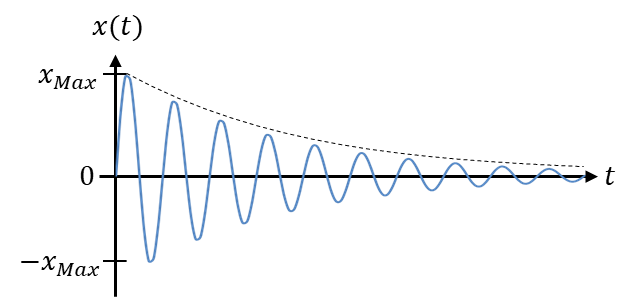
An oscillation can be started, for example, by a pulse. You can give a pendulum a single push by hand. The pendulum then reaches a maximum peak value in the first period, which then decreases. This oscillation eventually ends when all the energy of the oscillation has been converted into another form (e.g. heat).
You can also push the pendulum a little with every swing. This increases the peak value continuously. Only when the energy lost through friction is as large as the energy regularly supplied does the peak value reach its maximum. As long as you keep pushing, the oscillation is maintained.
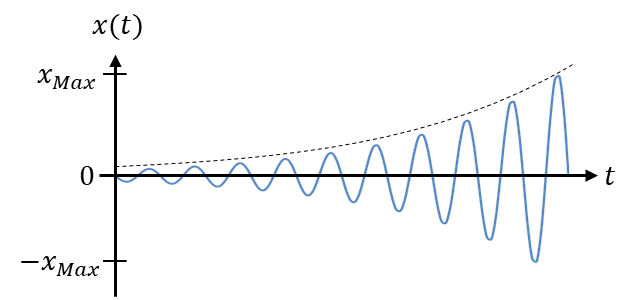
So we distinguish three kinds of oscillation: there are “decaying oscillations”, whose peak value decreases over time. In these systems the energy supplied is less than the energy given off. The peak value of a “sustained oscillation” remains constant over time if the energy supplied exactly equals the energy the system gives off. The peak value of a “growing oscillation” increases as long as the energy supplied is greater than the energy given off.
A change in energy is described by a supplied (positive) or removed (negative) power. Power corresponds to the rate of change of the energy of one form of energy. The exchange of energy between the two oscillating forms of energy is pure reactive power. In the pendulum example, this applies to the conversion between kinetic and potential energy. Energy supplied from outside (pushing) or removed (friction) is described mathematically by active power.