Op-Amp Input Behavior
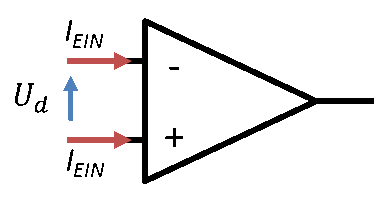
The op-amp has two inputs. The most important properties at the input of the op-amp are:
1. No current flows into the amplifier. So IEIN = 0 A.
2. In amplifier circuits with negative feedback, the voltage between the two terminals is 0 V. So the differential input voltage is Ud = 0 V. Both terminals have the same potential. However, there is no short circuit, so no current can flow from one input to the other.
Both are idealised assumptions that do not apply exactly in practice. For calculations on amplifier circuits, however, we always assume these properties.
The op-amp needs part of the supply voltage internally. So an operational amplifier can only process voltages at its inputs and at its output that are generally smaller than the supply voltage. The parameter “Input Common-Mode Voltage Range” describes which voltages the op-amp can process at its input. For the LM324, this range extends from the negative supply voltage to about 1.5 V (2 V over the full temperature range) below the positive supply voltage. With a supply of ±12 V, the input voltages should therefore lie between −12 V and about +10 V.