P and I Behavior
P behaviour and I behaviour can be combined in two ways.
P∙I behaviour
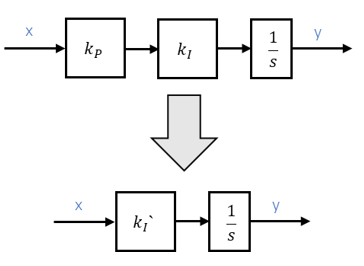
If blocks with P behaviour and I behaviour are connected in series, the transfer functions are multiplied. The overall behaviour then acts like I behaviour.
\[
k_I' = k_I \cdot k_P
\]
The two gain blocks can simply be combined. The type of behaviour remains I behaviour. Only the intensity of the behaviour changes.
P+I behaviour
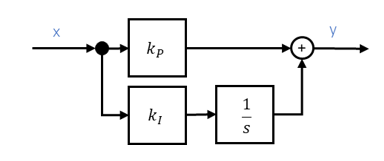
If P behaviour is to be added to I behaviour, we have to adapt the block diagram:
\[
\begin{gathered}
y = k_P \cdot x + k_I \cdot \frac{1}{s} \cdot x \\[6pt]
H = \frac{y}{x} = k_P + k_I \cdot \frac{1}{s}
\end{gathered}
\]
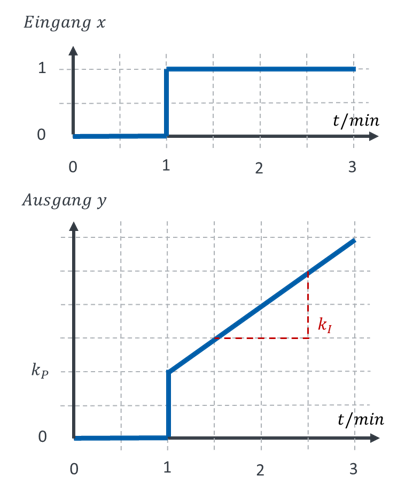
Let us look at the step response of this behaviour: through the P behaviour, the output quantity jumps up immediately at the step time. Then the I behaviour begins to take effect.
\[
\text{In this example: } k_P = 1 \text{ and } k_I = 1
\]
We do not consider P+I behaviour further in this tutorial, because the calculation in a control loop is difficult.