Feedback
The principle of feedback is a general approach for (technical) systems. It helps to keep a system permanently in a stable state. Feedback returns the output quantity to the input. Let us look at the simplified general control loop:
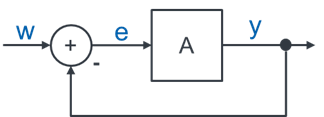
As an example, let us set w = 1 and A = 9. At the start, y = 0. What happens?
At y = 9, the output quantity is far too high. Through the feedback, it is subtracted from the reference variable w. In the second step:
If y has too high a positive value, e becomes strongly negative. This leads to an even larger negative value of y. The steps are not carried out one after the other in time; they take place simultaneously. If y deviates from the setpoint in one direction, the feedback immediately pushes y in the other direction. As a result, y does not deviate from the setpoint. Let us look at an analogy.
Analogy of the ball in the bowl

A ball lies in a concave bowl. If the ball is moved to the left, the slope of the bowl moves it back to the right. If it is moved to the right, the shape of the bowl pushes it back to the left. With a little friction, the ball does not keep rolling back and forth, but comes to rest in the middle of the bowl. The position of the ball is stable. This means that it will return to this position by itself if someone moves the ball out of the stable position.
Back to the control loop: if the output quantity is too large, the control loop reduces it. If the output quantity is too small, the control loop increases it. There is a stable state of the control loop in which the output quantity finds its equilibrium:
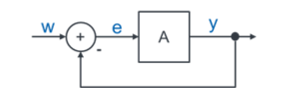
With the values given above, the quantities in the control loop no longer change. This is the stable state that the control loop maintains autonomously because of the feedback. If this equilibrium is disturbed from outside, the output quantity may briefly deviate from the stable state. The system itself ensures that the output quantity returns to the stable state.
Types of feedback
Feedback systems return the output quantity to the input quantity. If the output quantity is subtracted from the input quantity, we speak of “negative feedback”. Negative feedback is explained by the ball in the bowl.
We can also add the output quantity to the input quantity. In the analogy, we then turn the bowl upside down. The system will then stay in one of the two end positions: the ball lies either on one side or on the other. The position in the middle is unstable, so in practice the ball will not stay there for long. We do not consider this type of feedback here. It is called “positive feedback”.

Loop gain
The gain around the closed loop (the product of all transfer functions in the loop) is called the loop gain. In the control loop, the loop gain is given by the parameter A. The larger A is, the more strongly the control loop counteracts a deviation from the equilibrium. With a larger loop gain, brief deviations from the equilibrium lead to a stronger pull in the opposite direction. A larger loop gain also ensures that the output quantity deviates less from the setpoint.
Benefit of negative feedback
Thanks to negative feedback, a control loop does not need a babysitter constantly checking whether the output quantity is behaving and sitting at the right value. It works autonomously and is therefore much more reliable than a system with human intervention. Open-loop systems have no negative feedback. Open-loop systems need a babysitter.