Analog and Digital Values
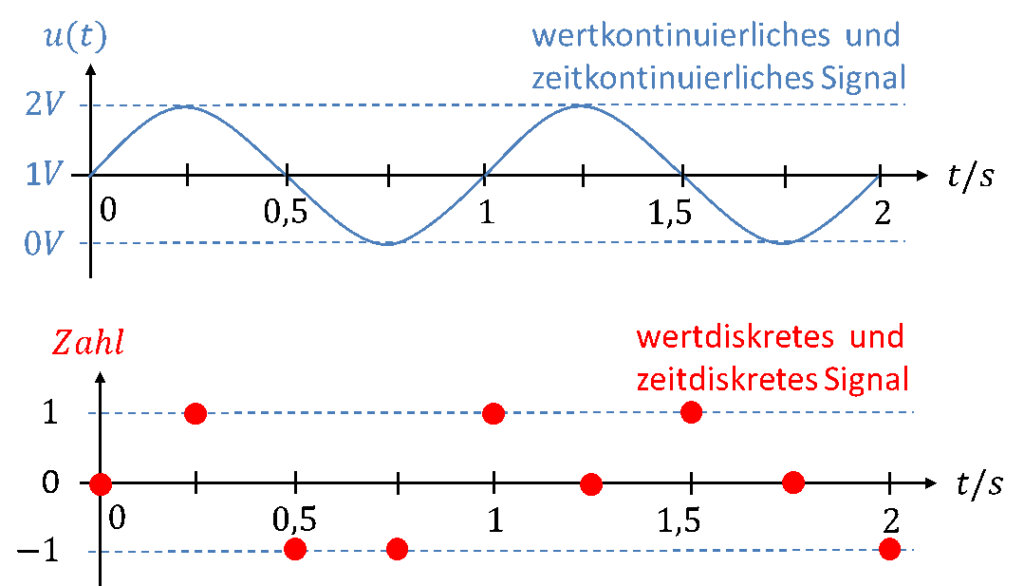
An analogue voltage is continuous in value and continuous in time. This means that at every point in time there is a current value of the voltage, which is generally not exactly equal to the value shortly before. So the analogue voltage changes constantly. This becomes particularly clear if we look closely enough, in the microvolt range. If we look at analogue signal curves on an oscilloscope, it becomes visible that there is no time at which there is no current voltage value. An analogue value can take any physically possible value. So it is continuous in value.
ADCs only output integers. They can certainly also be negative, but no numbers with decimal places are output. The result of an AD conversion can be a 5, but never a 5.1. Integers are not continuous in value, but discrete in value.
Converting a voltage into a number takes a time t. Depending on the ADC conversion principle, it takes a few nanoseconds or up to 100 microseconds. During this time, the voltage signal at the input of the ADC is sampled and held constant inside the ADC. This is important in order to capture accurately the voltage present at the input at a defined point in time. If the ADC continuously converts voltage values into numbers, a new voltage value is always recorded and converted into a number directly after one conversion.
So during the conversion, the DC voltage that was present at the external pins at the start of the conversion is applied inside the ADC. The information about the course of the analogue voltage between two conversions is therefore lost. New numerical values are output at the output of the ADC at fixed time intervals. The numbers are discrete in time, not continuous in time.
The analogue voltage signal is continuous in value and time. The numbers at the output of the ADC, on the other hand, are discrete in value and time. Information is lost during digitisation.