Half-Bridge
A half bridge consists of two switches connected in series to a (DC) voltage source. With two switches, 4 combinations of switch positions are possible.
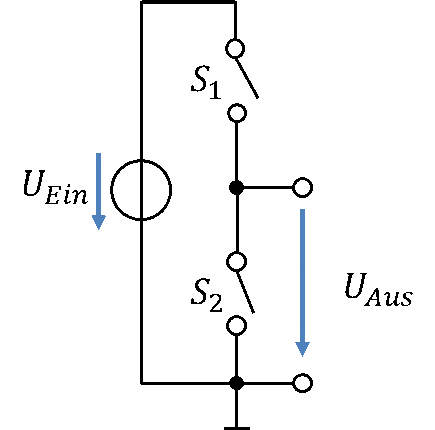
If the upper switch S1 is closed and the lower switch S2 is open, the output is connected to the input voltage. Then UAus = UEin. Conversely, if the lower switch S2 is closed and S1 is open, the output is connected to ground. Then UAus = 0 V. We can set the output voltage using the switches.
(Index Ein: input, Aus: output.)
Short circuit of the source
If both switches are open, the output voltage is not determined by the switches. Whatever is connected as a load to the output determines the value of the output voltage. If both switches are closed, the input source is short-circuited. What happens to the circuit then?
Closed switches have a very low on-resistance between the switching terminals. So two very small resistances are connected in series across the source. The output current of a voltage source is determined by the resistances loading it. Assume that each of them is RSchalter, geschlossen (switch, closed) = 100 mΩ. Then, in an electric car at U = 400 V, the following short-circuit current flows:
(Index Kurzschluss: short circuit.)
The current is extremely high; the switches are destroyed immediately by such a high current. The source cannot deliver the current either. It may also be damaged, especially if it is a battery. A short circuit of the source always breaks something; it must be avoided under all circumstances. Both switches must never be closed at the same time.
From now on, let us consider sensible switch operation: one switch must always be open and the other closed.