Resistor as a Component
Description
The formulas from the physical fundamentals apply to the resistor as a component:
The ohmic resistor is a linear component, because current and voltage are related linearly by a straight-line equation.
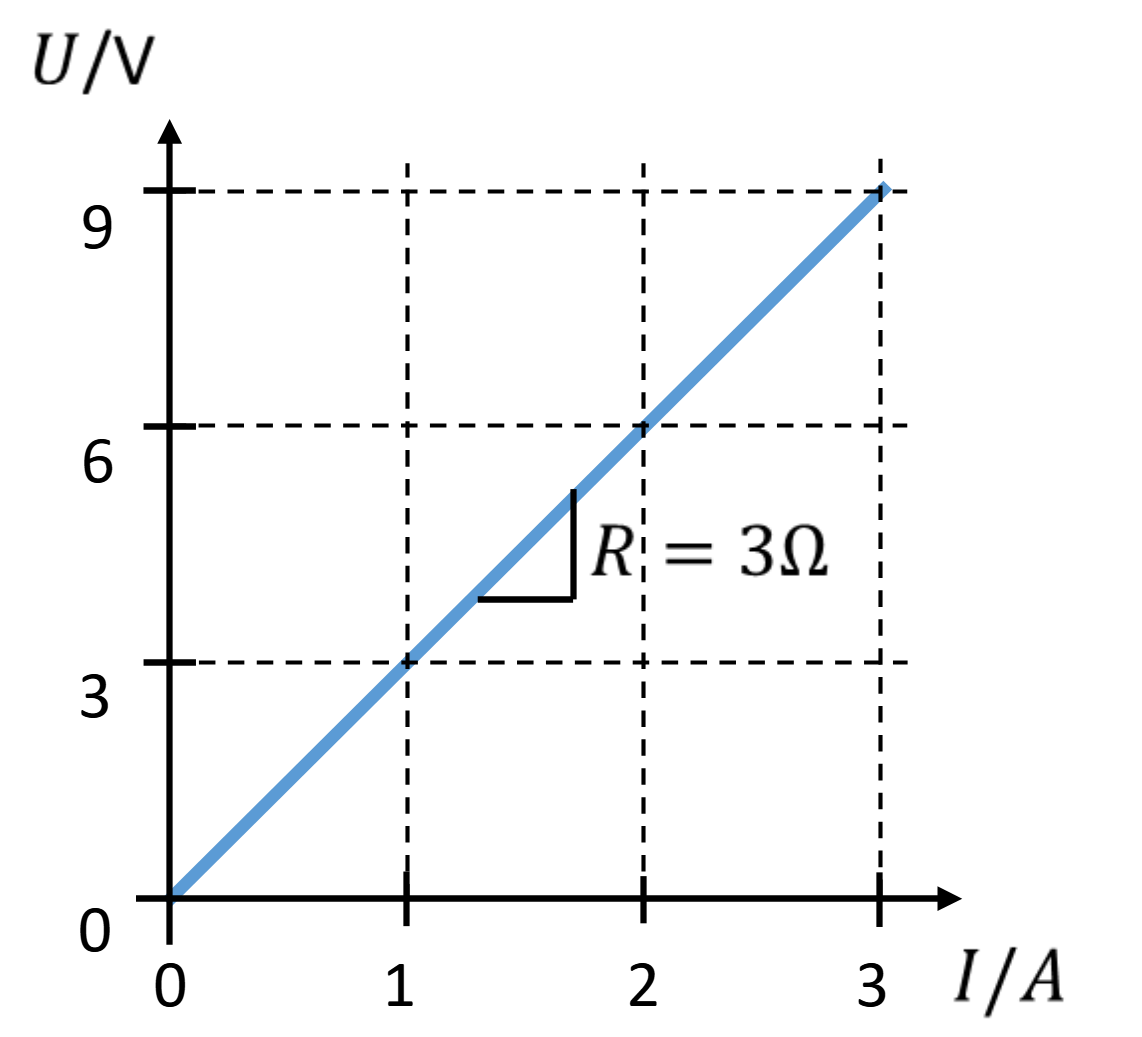
The slope of the straight line in the graph of U over I is the resistance value R.
Modelling
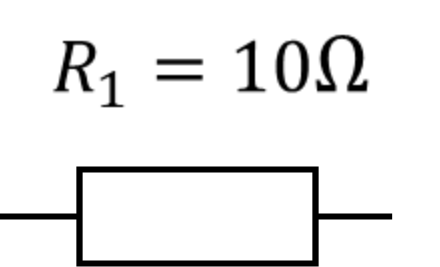
In the circuit diagram, a resistor is modelled as a rectangle with two terminals.
Power and energy
A resistor converts electrical energy into thermal energy. A resistor gets warm when current flows. It is thus the first representative of the components that convert energy into another form. For a resistor, the following applies:
At constant power (i.e. with constant values of U and I), the thermal energy in the resistor increases linearly. So the resistor gets warmer and warmer from a starting value. The starting value is the temperature of the resistor before the current flows.
Use in a circuit
The resistor is rarely used to generate heat. It is used for this, for example, in a hotplate. Usually, resistors of a certain size ensure that voltage and current at other loads in a circuit have the right values for operating these loads. More on this in the chapter on circuit analysis.