Linearity
A system is linear if its transfer function can be described mathematically by a straight-line equation. Its characteristic curve then has the shape of a straight line. Systems with a non-linear characteristic can, for example, behave as follows:
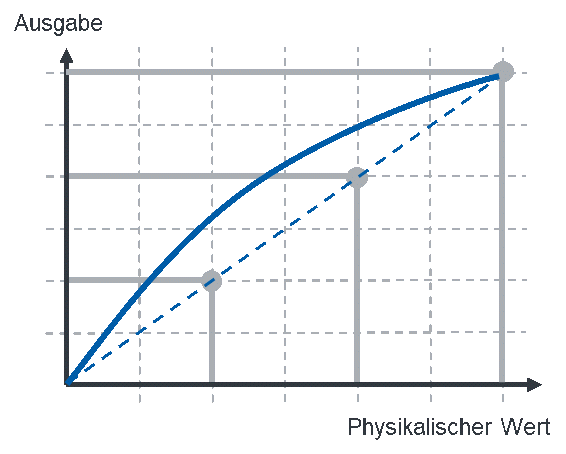
Non-linear behaviour is corrected via the inverse function. If, for example, a system has a characteristic of the form y = m∙x2, we apply a square-root function to the result in the digital signal processing in the microcontroller. In the source code, this looks as follows:
Linearisierter_Wert = SQRT(Steigungs_Kompensierter_Wert)
(linearised value = square root of the slope-compensated value.) The term SQRT stands for the square-root function. The challenge is to determine the function of the characteristic and then to find an inverse function. Toolboxes in Excel and Matlab help with this; they solve such problems with spline algorithms.