Steady-State Error
If the system shows P behaviour or PT1 behaviour, the reference response of the controlled system has a steady-state control error. The larger A, the smaller it is. If the system contains a storage element with integrating behaviour, the reference response of the controlled system has no steady-state control error. As a reminder, please read the chapters on behaviours in the control loop again.
Let us first look at a system with I behaviour. In the control loop of this system there is no steady-state control error. That is why we do not consider such systems here; there is no problem to solve.
Next, let us look at a system with P behaviour or PT1 behaviour. If a steady-state control error is permissible, we first check how large it is with a P controller with kPR = 1. This controller does not change A. So with it you can only calculate the system in the control loop without the controller intervening.
If the control error is already small enough, we do not need to do anything more in the controller. If the control error is too large, we must increase the gain kPR in the controller.
Example
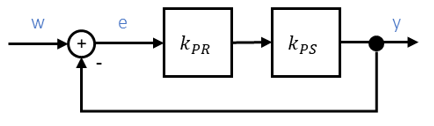
The system contributes kPS = 10. So the control error is 1/(1 + 10) ≈ 9 %. In the example, a maximum control error of 1 % is required. That is why A must be at least 100. So we need kPR = 10 at the controller.
We can calculate with a PT1 system in exactly the same way. Here we consider the steady state and the steady-state control error. The procedure for dimensioning the controller is mathematically more difficult, but in principle the same as for a P system.
What do we do if no steady-state control error is permissible in a system with P behaviour or PT1 behaviour? We add I behaviour in the controller. For simplicity, we consider a pure I controller. You can also take a complex controller that has, among other things, I behaviour.
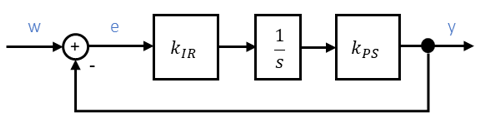
As soon as I behaviour has been introduced into A, there is no steady-state control error. What influence does the controller’s kIR have? Let us look at the transition range:
The larger kIR, the smaller τFÜ, and the faster the controlled system reaches the steady state.
You will notice at this point that I no longer present general solutions, only examples. There is no general solution for selecting the controller type and designing the controller parameters. It always depends on the requirements for the controlled system and on the behaviour of the system.