Diode in the Water Model
In the water model, a diode is represented as a valve. Water is to flow in a pipe that is kept closed by the valve. The movable orange valve ball blocks the opening for the water. A spring pushes the ball to the right so that the opening stays closed. The water can flow around the spring.
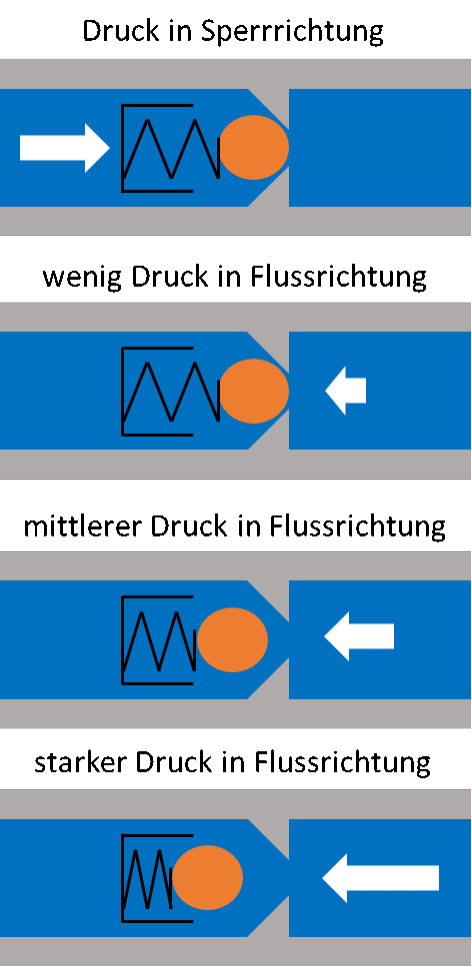
Top figure: If the water pressure acts from the left (in reverse direction), the ball is pressed even more firmly into the opening. The valve stays closed and no water flows.
Second figure: If the water pressure acts from the right, the ball is pushed open against the spring force. If the pressure is too low, the valve stays closed. Here the pressure acts in the forward direction.
Third and fourth figures: If the water pressure exceeds the spring force, the valve opens. The stronger the pressure, the further the valve opens, so that more water flows.
In the analogy, the flow speed of the water corresponds to the current. The water pressure corresponds to the voltage. If a voltage is applied to a diode in the wrong direction (“reverse direction”), no current flows. Only when a voltage greater than a minimum voltage is applied in the “forward direction” does the diode start to conduct current. The current depends on how much the applied voltage exceeds the minimum voltage.