Alternating Current
So far, we have looked at voltages and currents that are constant over time. The alternating voltage provided by a mains socket is sinusoidal and therefore not constant over time.
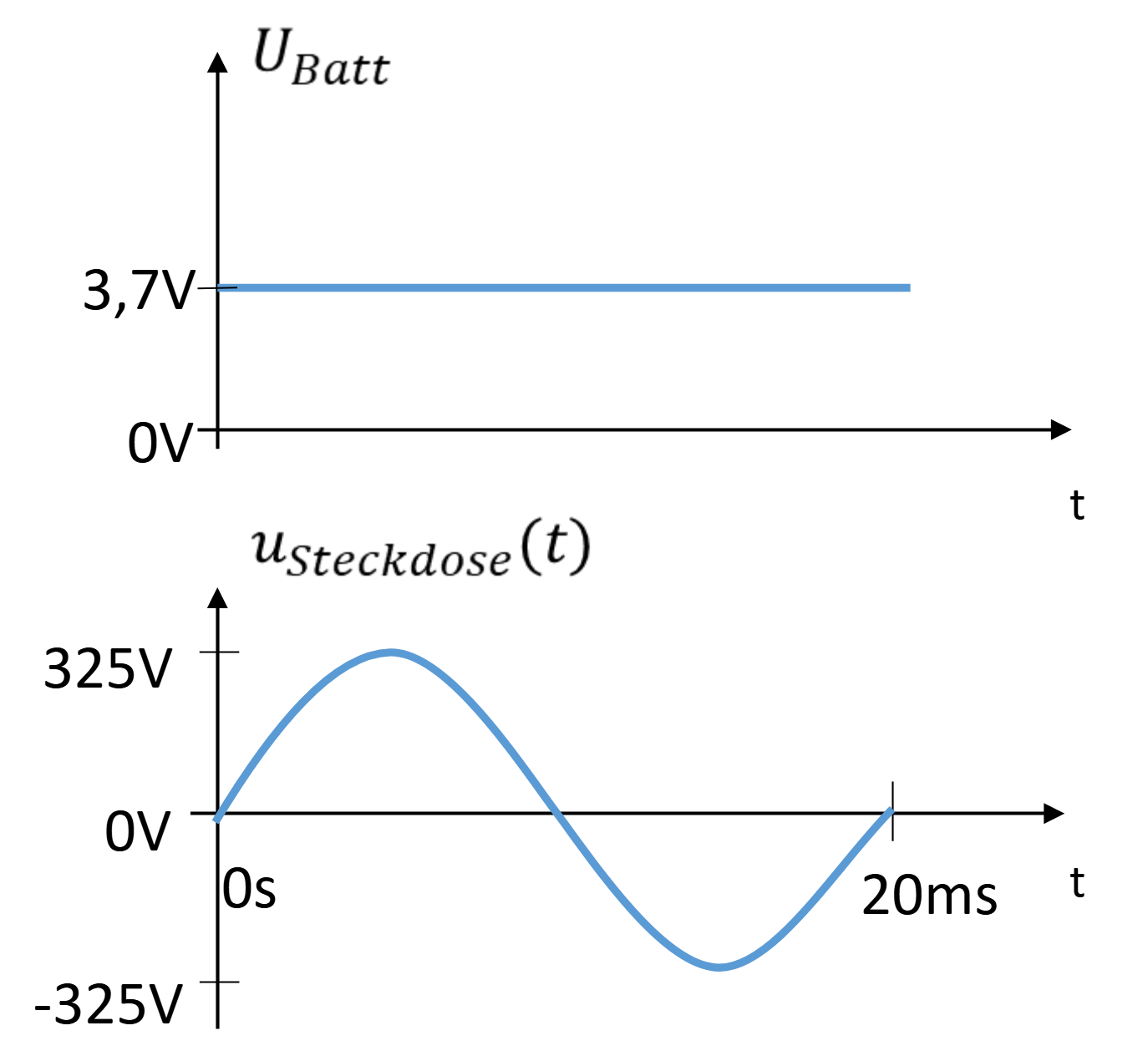
To distinguish “DC quantities” that are constant over time from “AC quantities”, we use upper-case letters for DC quantities and lower-case letters for AC quantities. AC quantities change over time; they are not constant. That is why we write an alternating voltage as u(t).
Why should we deal with AC quantities? Here are some fields of application from practice:
- In medical technology, alternating fields for ultrasound, MRI etc. are generated from alternating current.
- Smartphones communicate via WLAN or Bluetooth. Both radio standards use alternating currents to make digital information (“0” or “1”) distinguishable. The carrier frequency of 2.4 GHz describes a parameter of AC quantities: the frequency.
- In power engineering, the conversion between electrical and kinetic energy in motors and generators is mostly done with alternating current. Every mains socket supplies an alternating voltage.