Simplified Water Model
This chapter is optional and not relevant for the exam. It tries to explain the relationships at a capacitor with alternating current in an intuitive way.
To explain the relationship between voltage and current at a capacitor with alternating current, we return to the analogy of the water bucket with inflow and outflow from the chapter Calculating with energy stores. Here is the graphic once more:
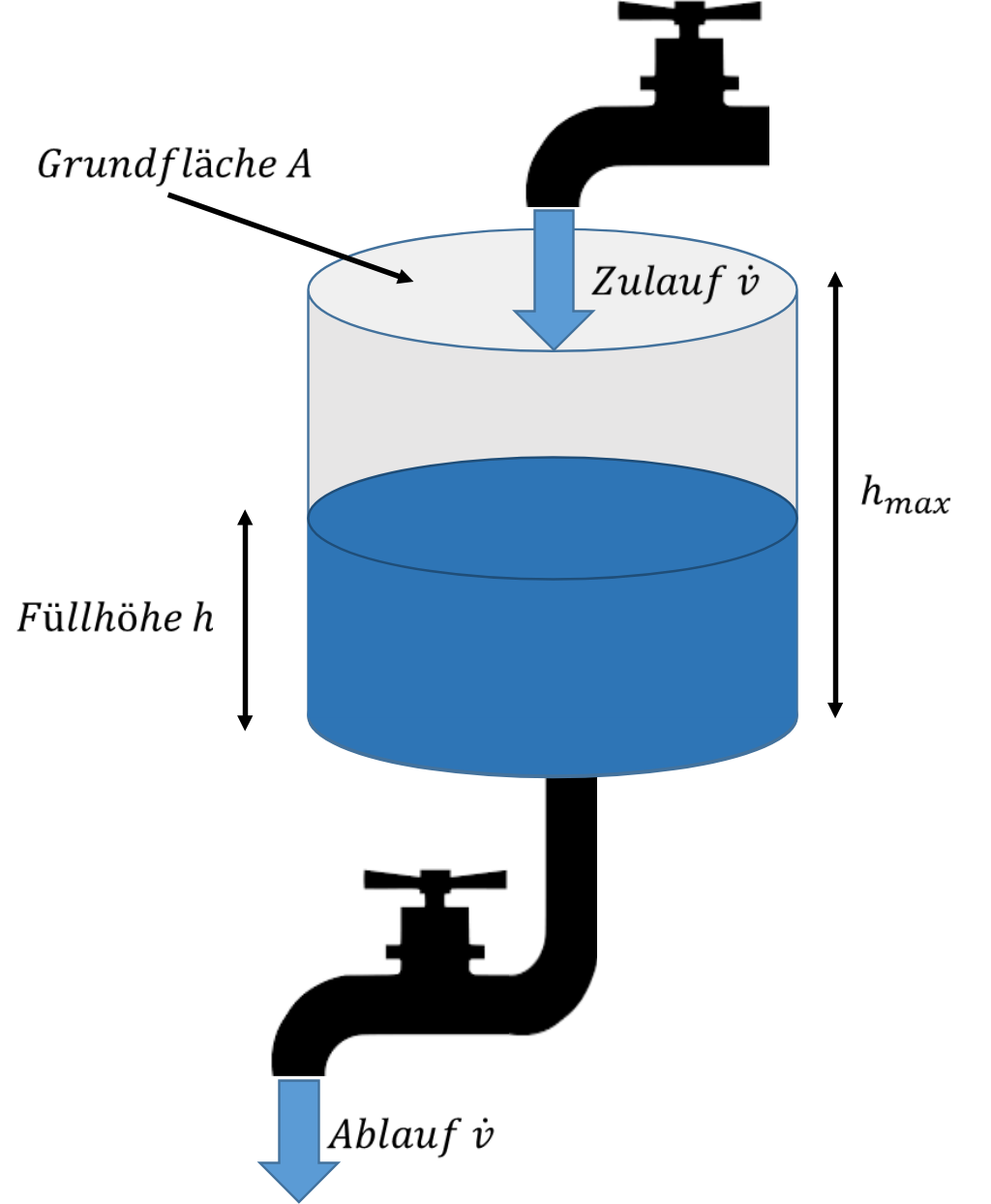
To explain alternating voltage and alternating current, the water flows in and out through the taps sinusoidally. As a result, the fill level of the bucket changes sinusoidally.
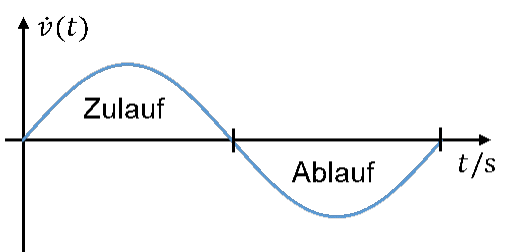
In the analogy, the capacitor corresponds to the bucket. The following applies:
As the input quantity, we specify a sinusoidal inflow. As the output quantity, we look at the resulting fill level. For the capacitor, this means: we specify the current and look at the voltage as the result or output. Please read the chapter Sinusoidal excitation again.
Phase shift
In the chapter Sinusoidal excitation, we found that the fill level is always at its maximum when the inflow was positive and has its zero crossing, i.e. when filling has finished and emptying begins. While the inflow is positive, the fill level rises. As long as the inflow is negative (i.e. water is flowing out), the fill level falls.
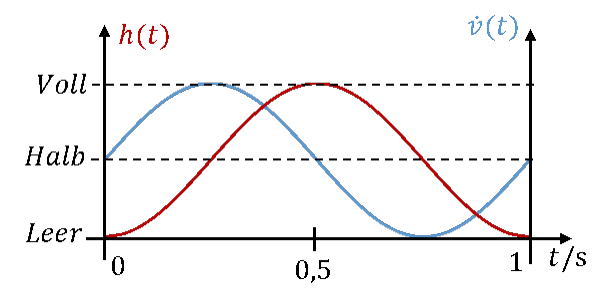
If the inflow is sinusoidal, there is a phase shift of a quarter period between the inflow and the fill level. The inflow is ahead of the fill level in time.
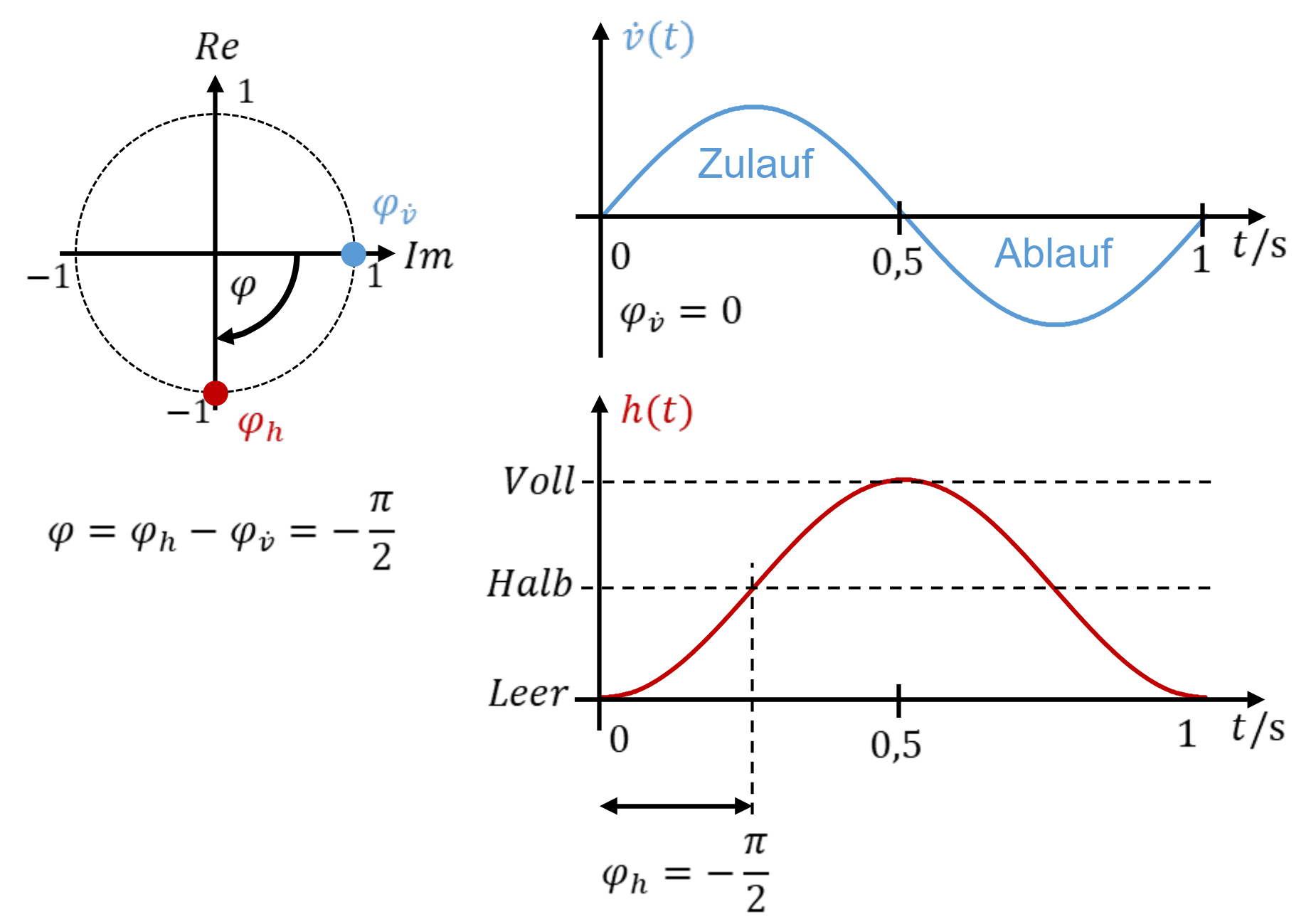
The fill level lags behind the inflow. If the inflow has no phase shift, the fill level is phase-shifted by φh = −π/2.
Every energy store has a phase shift of ±π/2 between inflow and fill level if its inflow changes sinusoidally. This also applies to voltage and current at the components inductor and capacitor. You will see later that the shift is +π/2 in one case and −π/2 in the other.
The voltage across the capacitor is calculated from the integral of the current over time. The integral over time represents the sum of the current in the past. So it is also understandable from the integration that a positive current only results in a positive voltage after a time delay.
Frequency dependence
Next, let us look at how the inflow and fill level depend on the frequency of filling and emptying. If the bucket is filled and emptied at f = 1 Hz, it is completely filled and completely emptied once within one second.
We now assume that the taps are opened so far during filling that the fill level of the bucket varies between completely empty and completely full. Now we double the frequency of filling. We open and close the taps faster, but we still open them just as far as before.
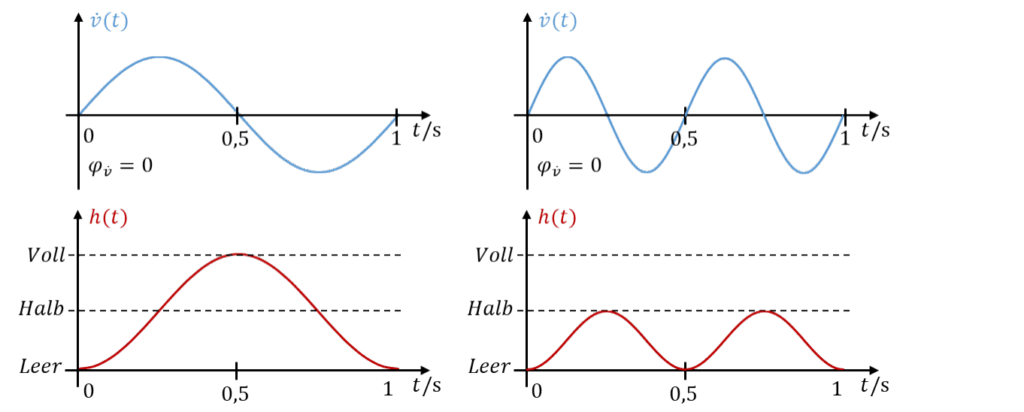
At the top left of the picture, you see filling and emptying at f = 1 Hz, which you already know. At the top right, the same bucket is filled and emptied with the same peak value and double the frequency. One period now lasts T = 0.5 s. The process of filling and emptying is then over twice as fast.
At f = 2 Hz, only half as much water has flowed into the bucket. That is why the fill level only rises to half full. Evidently, the fill level depends on the frequency if we leave the peak value of the inflow unchanged. The fill level halves when the frequency is doubled. Of course, the fill level still also depends on the peak value of the inflow.
Let us move from the water model to electrical engineering. The capacitor is the bucket. Its fill level is the voltage and the inflow rate is the current. At the capacitor (bucket), the voltage (fill height) depends on how fast the current (inflow rate) changes. So the voltage across the capacitor uC is inversely proportional to the frequency f with which the current iC changes. Voltage and current are both sinusoidal here; otherwise it becomes more complicated. The following applies:
For sinusoidal curves, we use the angular frequency ω instead of the frequency f. With ω = 2πf, we can also write:
Dependence on the area
Let us now compare two buckets. They are identical except for their base area. The following applies:
The same amount of water leads to a fill level in bucket 1 that is twice as high as in bucket 2. Let us assume that the taps are turned on so far that bucket 1 is completely filled and emptied. Then the filling looks like this:
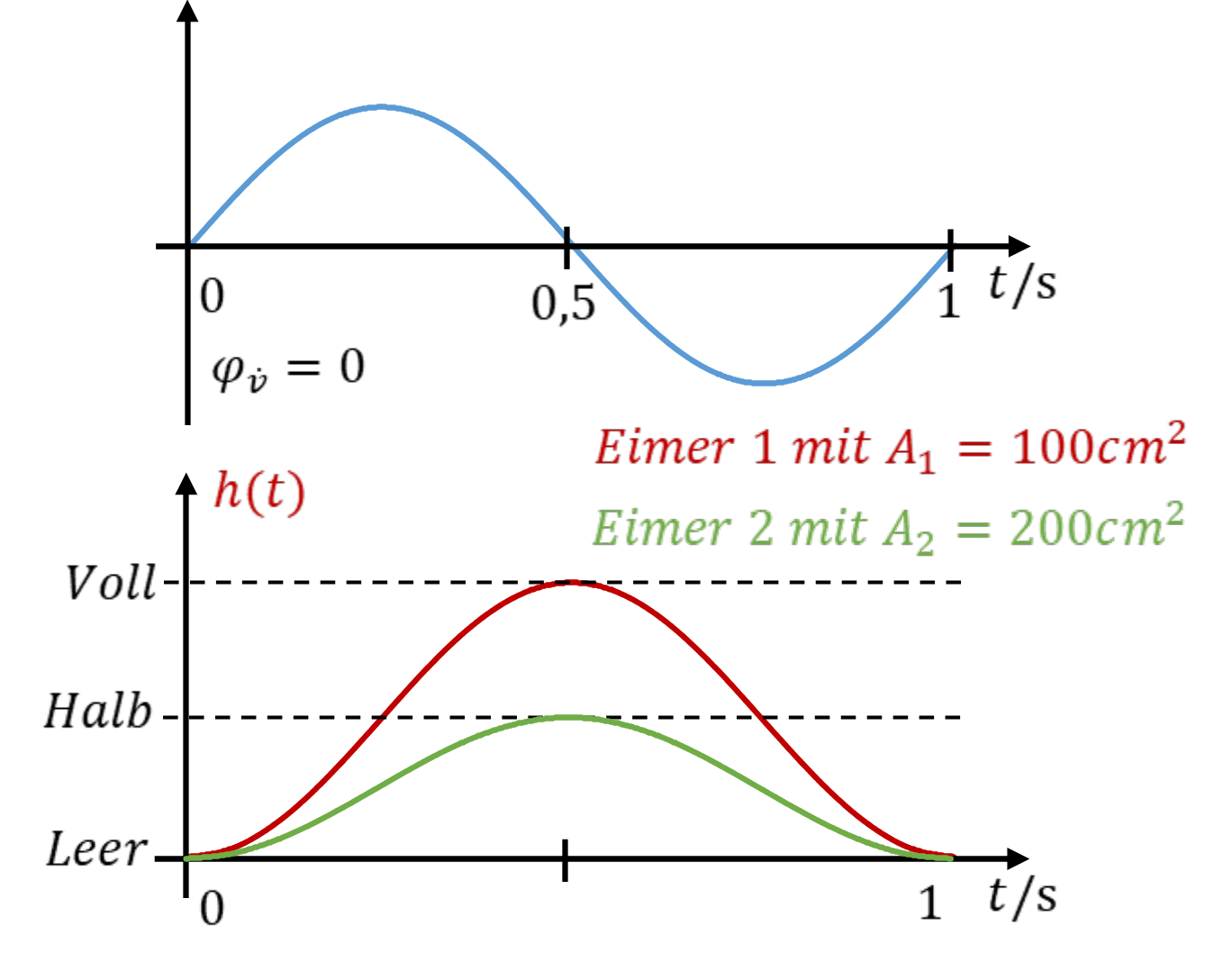
So the fill level depends on the base area of the bucket. In the analogy to electrical engineering, the voltage across the capacitor therefore depends on the capacitance C of the capacitor. The following applies
We have thus discussed intuitively all the parameters that make up the reactance of a capacitor. Overall, the following applies: