The Measurement Chain
A physical quantity is present at the input of a measurement system. A number is output at the output as the measurement result. In between, the measurement signal passes through various processing steps, which are explained in this chapter.
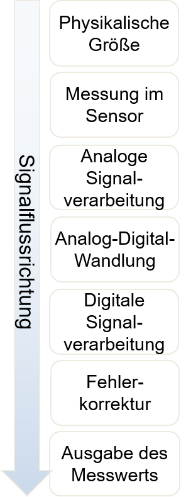
This introduction briefly covers the processing steps that are discussed in detail in the course of the lecture.
Sensors
Sensors convert physical quantities into analogue electrical quantities. Electrical quantities are, for example, current, voltage, frequency, resistance value or also time information that shows up in electrical quantities. There are, for example, temperature-dependent resistors (e.g. Pt100) whose resistance value changes with temperature.
Sensors are technical sense organs. They give technical systems information about the environment, as the eyes or the skin do for humans.
Sensors are generally bought in and not developed in-house. Your task is therefore limited to choosing the sensor that suits the application (accuracy, robustness, cost). In the measurement technology lecture, only a few sensors are discussed in more detail in the next chapters.
Analogue signal processing
The analogue electrical quantity output by a sensor is to be digitised in the measurement chain. For this, it is necessary to convert this electrical quantity into a voltage within a certain range of values. The reason lies in the properties of an analogue-to-digital converter, which is discussed in the next section.
The main task of the analogue signal processing is to convert the general electrical quantity into a voltage. If the temperature is to be measured with a temperature-dependent resistor, the temperature first changes the resistance value of the sensor. In the analogue signal processing, a change in voltage is generated from the change in resistance.
Microcontroller
The measurement signal passes through the following processing steps in the microcontroller:
1. Analogue-to-digital conversion
An analogue-to-digital converter (ADC) outputs a number that is proportional to the input voltage. This number can, for example, be processed further in a microcontroller (Arduino). Analogue-to-digital conversion often takes place inside a microcontroller.
2. Digital signal processing and error correction
In this block, software is programmed to change the number output by the ADC further. The output value can, for example, be corrected, or a unit can be assigned to it.