Discrete Controllers
Discrete controllers are used for actuators that cannot process continuous values at their input. One example is a heater that can only be switched on and off, i.e. whose heating power only knows the states full power or off.
In on-off (two-position) control, such an actuator is driven by a signal that only has two states. In digital technology these are usually “HIGH” and “LOW”. When driven with LOW, the actuator is off; with HIGH it is on.
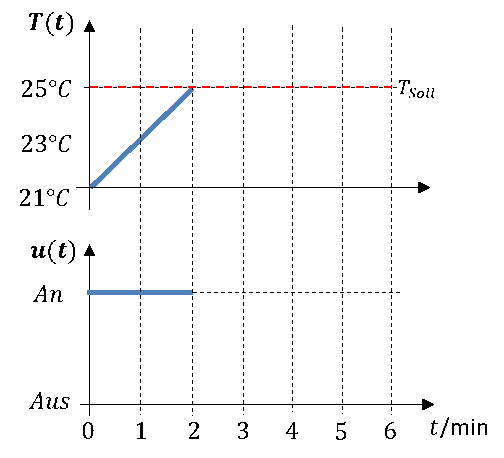
The controller always changes its output value depending on the control error at its input. In discrete controllers, thresholds are defined with which the input signal is compared. The principle is easy to understand with an example. We look at temperature control in a room. At the start, the room temperature is 21 °C. It is to be controlled to 25 °C with a heater that only knows the states u = ON and u = OFF. First the heater must be ON for some time. As a result, the room temperature rises over time t until it reaches the setpoint of 25 °C.
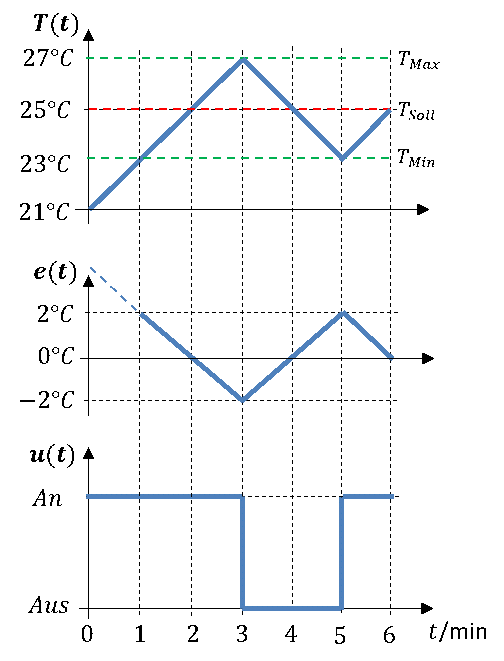
If the heater now stays ON, the temperature continues to rise above the setpoint. If we switch it OFF, it falls below the setpoint again. That is why we define two limits for the temperature, which we place around the setpoint at 23 °C and 27 °C. If the temperature exceeds the upper limit of 27 °C, the heater is switched OFF. If it falls below 23 °C, the heater is switched ON again. The following behaviour results:
The limits can also be set closer around the setpoint. Then the control error is smaller. However, the actuator then has to switch more often. The following figure shows the behaviour for a control error half as large:
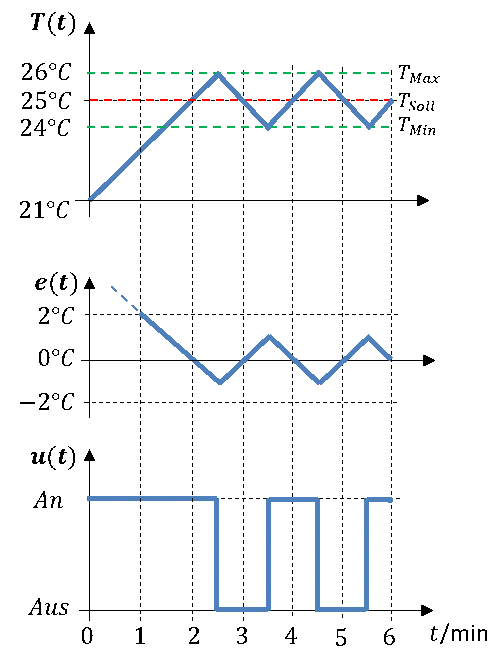
An actuator is often only designed for a certain number of switching cycles; it breaks down sooner if it switches too often. So we have to find a compromise between service life and control error.
You can also drive actuators that can process continuous drive signals in a discrete way. In this way you turn a continuous system into a discretely controlled system. This is generally much easier than designing a continuous controller. However, the application must allow the controlled variable to fluctuate constantly around the reference variable, without there being a steady state.