Static Magnetic Field
You know magnetic fields from magnets that attract other magnets or iron. In this tutorial we call these magnets permanent magnets. They cause a magnetic field in their vicinity. Permanent magnets alone are only of limited use for technical purposes, because their field cannot be changed or switched off.
Moving electric charge in the form of an electric current also causes a magnetic field. Every current through a cable therefore results in a magnetic field. This magnetic field can be changed via the current, which is why in this tutorial we concentrate on this way of generating magnetic fields.
When current flows through a long straight wire or conductor, a magnetic field already forms around the wire. It is oriented in circles around the wire. Once again we determine the direction of the field not from formulas but with a rule of thumb: the “right-hand rule” states:
The thumb points in the direction of the current (conventional current direction)
The remaining, slightly curled fingers of the right hand point in the direction of the field
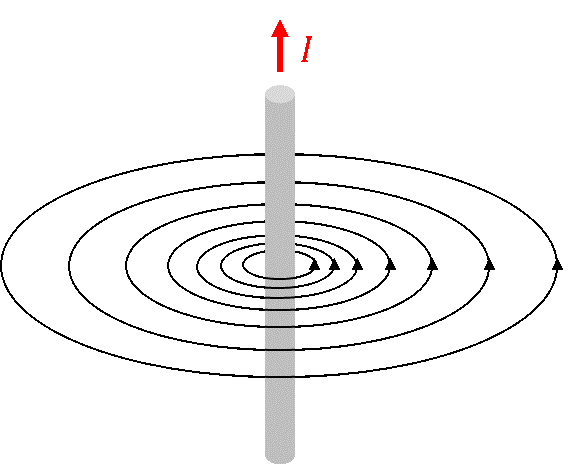
The intensity and direction of the magnetic field are again described by field lines. The density of the field lines indicates the intensity of the field. It is high close to the wire and decreases sharply with increasing distance.
Field lines of magnetic fields are always closed. They have no beginning and no end. In electric fields they always point from the positive charge to the negative charge and connect them. There, the field line has a clear beginning and end.
Coupling
Electric current through a conductor causes a magnetic field. Conversely, a magnetic field causes an electric current in a conductor. The principle is bidirectional. In a circuit with inductors you must always take care that the magnetic fields of the inductors do not unintentionally generate currents in other parts of the circuit.
Let us look at two cables running in parallel. Current flows in the first cable. The current IErzeuger generates a magnetic field around the cable. The second cable lies in this magnetic field. The magnetic field generates (bidirectional effect) a current IEingekoppeltin the second cable.
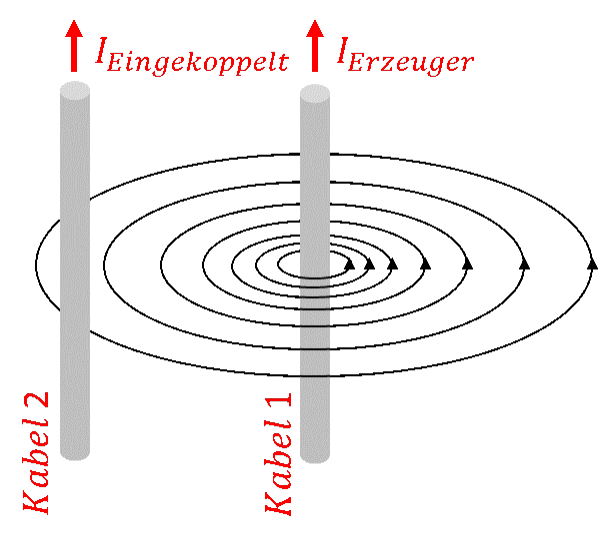
The second cable thus carries an unwanted current just because it was laid directly next to the other cable.
Note: This is a strong simplification: the coupling takes place via the induction of a voltage, which then results in a current. But we do not go that deep into the physics at this point.
Wanted and unwanted fields are found everywhere in power electronics circuits (and control cabinets). These fields unintentionally cause currents in neighbouring parts of the circuit that disturb these other circuits. Fields act particularly intensively on cables (long electrical conductors), which “soak up” fields like antennas. Many fields are generated by cables. We also call generators and receivers of fields “antennas”. You must protect circuit parts and cables against magnetic fields by shielding.
A shield consists of magnetically conductive material. A cable can, for example, be sheathed with a metal braid. In the home this is done above all with network cables (CAT). The metal braid acts as a shield against fields. As a result, the cable emits fewer fields and also picks up fewer external fields.
When a magnetic field hits a shield, a current flow is generated in it. This current flow produces electrical power in the resistance of the shielding material. This reduces the energy and thus the intensity of the magnetic field. The current in the shield must be drained somewhere. That is why we normally connect the shield to ground or, in a control cabinet, to PE or FE (functional earth).