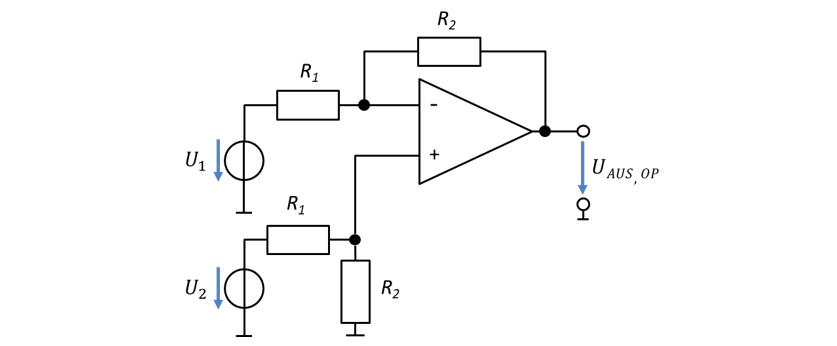
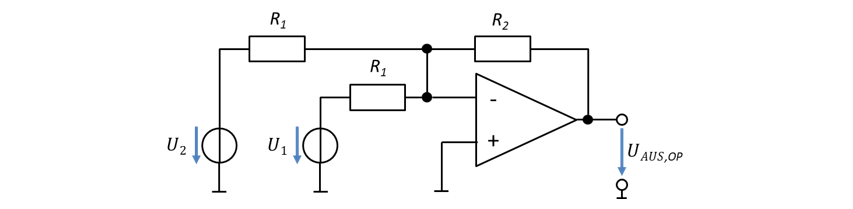
Choose the shift voltage so that the lower range limit of the sensor voltage becomes 0 V and the shifted sensor voltage is only positive. Gain: \(v = \dfrac{U_{\mathrm{ADC,Max}}}{U_{\mathrm{Sensor,verschoben,Max}}}\) (verschoben = shifted)
Choose the shift voltage so that the upper range limit of the sensor voltage becomes 0 V and the shifted sensor voltage is only negative. Gain: \(v = \dfrac{U_{\mathrm{ADC,Max}}}{U_{\mathrm{Sensor,verschoben,Min}}}\)
\[
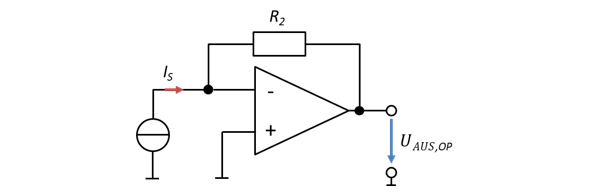
\text{I-U converter: } U_{\mathrm{Aus,OP}} = -R_2 \cdot I_S,\quad H = v = \frac{U_{\mathrm{Aus,OP}}}{I_S} = -R_2
\]
\[
\text{Buffer: } U_{\mathrm{Aus,OP}} = U_{\mathrm{Ein,OP}},\quad H = v = 1
\]
Used for decoupling signals. No current flows out of the input source; the (real) source is not loaded.
\[
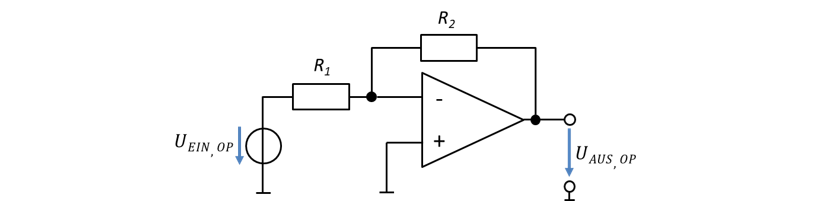
\text{Inverter: } U_{\mathrm{Aus,OP}} = -U_{\mathrm{Ein,OP}},\quad H = v = -1 \text{ with } R_1 = R_2
\]
Special case of the inverting amplifier for inverting a signal (multiplying by −1).
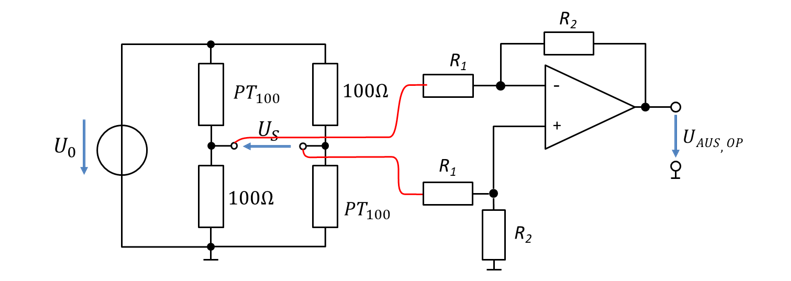
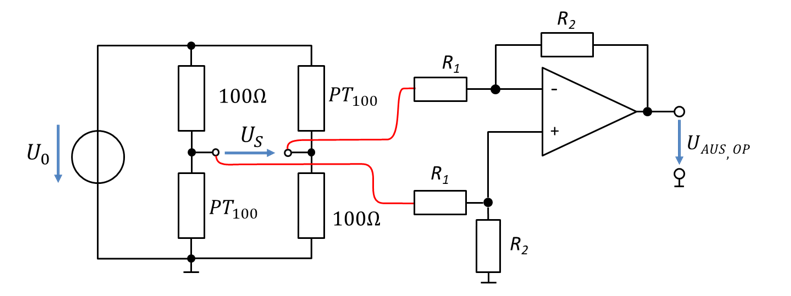
The bridge can also be populated the other way round, so that the left and right branches are swapped. The formula above still applies:
\[
\begin{gathered}
\text{Instrumentation amplifier: } U_{\mathrm{Aus,OP}} = G \cdot (U_2 - U_1) \\[6pt]
G \text{ is given in the problem and depends on the op-amp. Example: } G = \frac{R_G}{1\,\mathrm{k\Omega}}
\end{gathered}
\]
Aus = out (output)
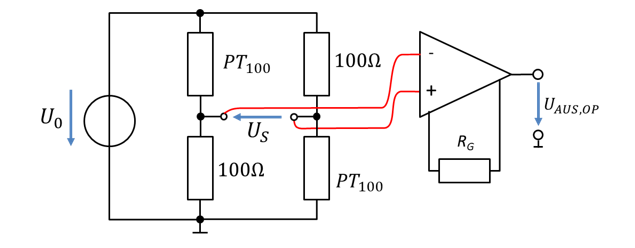
Op-amp solution for amplifying a differential voltage without loading, e.g. at the output of a bridge circuit. Unlike with the differential amplifier, no current flows out of the bridge.
\[
\begin{gathered}
\text{Instrumentation amplifier at a bridge: } U_{\mathrm{Aus,OP}} = G \cdot U_S \\[6pt]
G \text{ is given in the problem and depends on the op-amp. Example: } G = \frac{R_G}{1\,\mathrm{k\Omega}} \\[6pt]
U_{\mathrm{Aus,OP}} = G \cdot U_S \approx G \cdot \left(U_0 \cdot \frac{0.4\,\frac{\Omega}{°\mathrm{C}} \cdot T}{200\,\Omega}\right)
\end{gathered}
\]