Amplifiers
The task of analogue signal processing is to adapt the output signal of the sensor to the input voltage of the ADC. In this chapter, you will learn how this works. To do this, we first look at amplifiers as components and then at amplifier circuits.
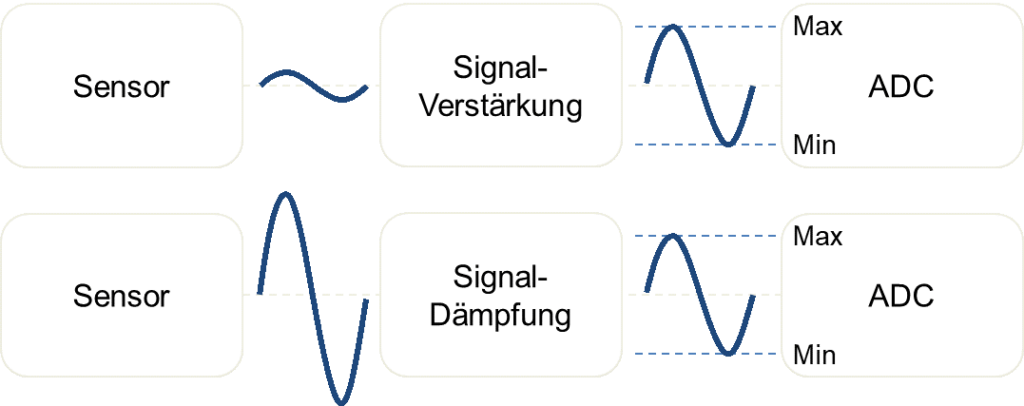
In the example of the robot vacuum cleaner, a sensor converted the distance [0 cm .. 30 cm] into the voltage range [0 mV .. 30 mV]. The ADC needs a voltage in the range [0 V .. 3 V] at its input. So the voltage must be amplified by a factor of 100.
In some cases, the sensor signal is larger than the input voltage range of the ADC. Then the signal must be attenuated, i.e. its voltage value must be reduced. The sensor signal is divided by a factor. Instead of dividing by a factor, we can also multiply by the reciprocal of the factor. In this way, we cover both cases with multiplication; for signal attenuation, the magnitude of the factor is simply smaller than 1.
Amplifiers are used to multiply the signal by a factor. In measurement technology, we use operational amplifiers (abbreviated op-amps; in the figures “OP”) for this.
First, we only consider voltage amplification. The op-amp is to amplify an input voltage of, for example, UEIN,OP = 5 mV by the factor v = 1000 to the output voltage UAUS,OP = UEIN ∙ v = 5 V. The gain v corresponds to the factor by which the signal amplitude is to be multiplied.