Operational Amplifiers
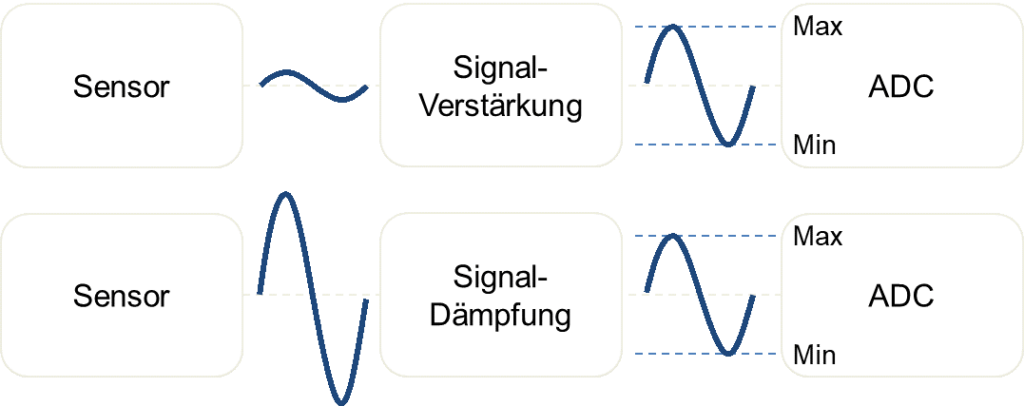
It is generally difficult to convert a physical quantity into an electrical quantity in a sensor at all. The electrical quantity often changes only very slightly with the physical quantity. The sensitivity of sensors is then low. In the example of the PT100 on the current source, the range of the sensor voltage was US = [1 V .. 1.4 V] for T = [0 °C .. 100 °C] and I0 = 10 mA. The input voltage range of the ADC, however, is, for example, UEIN,ADC = [0 V .. 3 V]. For optimal use of the ADC input voltage, the sensor signal would have to be about a factor of 2 larger. For this, the slope of the characteristic of the sensor circuit would have to be about a factor of 2 larger.
In some cases, the sensor signal is larger than the input voltage range of the ADC. Then the signal must be attenuated, i.e. its amplitude must be reduced. The sensor signal is divided by a factor. Instead of dividing by a factor, we can also multiply by the reciprocal of the factor. In this way, we cover both cases with multiplication; for signal attenuation, the magnitude of the factor is simply smaller than 1.
Amplifiers are used to multiply the signal by a factor. In measurement technology, we use operational amplifiers (abbreviated op-amps; in the figures “OP”) for this.
First, we only consider voltage amplification. The op-amp is to amplify an input voltage of, for example, UEIN,OP = 5 mV by the factor v = 1000 to the output voltage UAUS,OP = UEIN ∙ v = 5 V. The gain v corresponds to the factor by which the signal amplitude is to be multiplied.