Diodes in Circuits
A diode is a non-linear component. Its characteristic curve is not proportional. Nevertheless, calculating voltage and current in many circuits is simple. If the current through the diode is determined by the circuit, approximately the forward voltage drops across the diode. In practice we rarely calculate with the diode resistance; we usually do not need to calculate the diode voltage that precisely.
If the diode is to conduct current, we apply a voltage slightly higher than the forward voltage. The current is then normally not set by the exact voltage value but limited by the rest of the circuit. Let us look at an example:
Diode and resistor
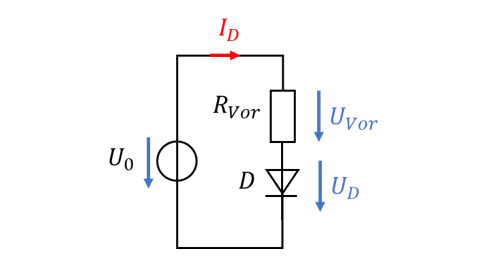
(Index Vor: series resistor.)
The diode current is usually determined by the other components in the circuit, not by the diode voltage. When the diode conducts, we take the forward voltage into account in the meshes to calculate the current. In power electronics circuits with voltages of several 100 V, even the forward voltage is often neglected. Then we only check whether the diode conducts or blocks.
If the resistor in the circuit above were smaller, more current would flow. The resistance is in the denominator of the current equation. The current depends only slightly on the diode voltage, which is often small compared with the supply voltage. It is mainly determined by the rest of the circuit.
Diode and inductor
An advantage of diodes over actively controlled switches is that you cannot forget to switch them, because they switch by themselves. This is particularly important when the current from an inductor has to continue flowing somewhere. Diodes are often simply connected in parallel with inductors to ensure that the inductor current can never be interrupted. Here is an example:
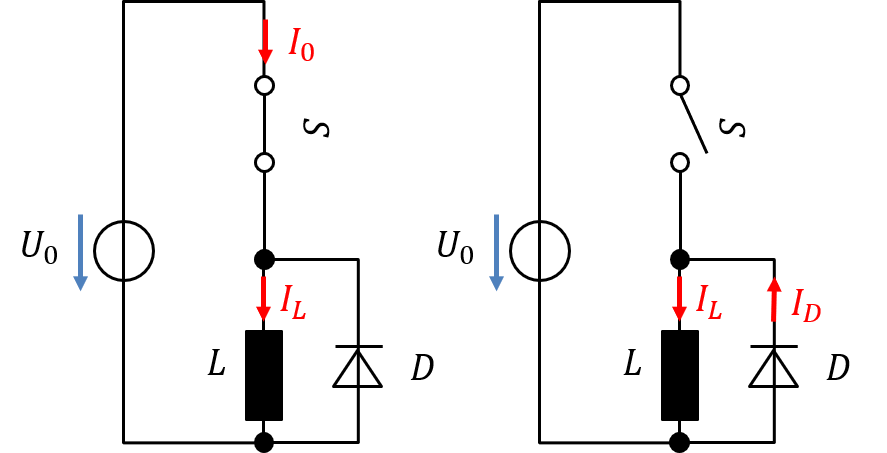
The diode is installed so that it does not conduct the current I when the switch is closed (left figure). It only conducts current that flows through it from bottom to top. When the switch is closed, a current builds up in the inductor. When the switch is opened (right figure), the current continues to flow through the inductor in the same direction. Without a diode, the current would be interrupted, which would destroy the switch. The inductor current now flows round in a circle through the diode.