Sensors
In this tutorial, we only discuss one sensor as an example: the PT-100 temperature sensor. With this sensor, the physical quantity temperature acts on the resistance value R of the sensor. If you can handle this sensor, you can also handle all other sensors in which the physical quantity changes the resistance value.
There are many sensors that cause, for example, a change in voltage or a change in current. Evaluating these sensors is much easier. You will learn how to do this in the chapter on analogue signal processing. Here we deal with the sensors that need complicated signal processing. You will then be able to handle the simple ones too.
First, let us look again at the measurement chain for a convention for naming quantities:
Signal naming
The function block analogue signal processing prepares the sensor voltage for digitisation. Accordingly, in the block diagram of the measurement chain it lies between the sensor and the ADC. The input quantity of the analogue signal processing is the output quantity of the sensor. The output quantity of the analogue signal processing is the input quantity of the ADC.
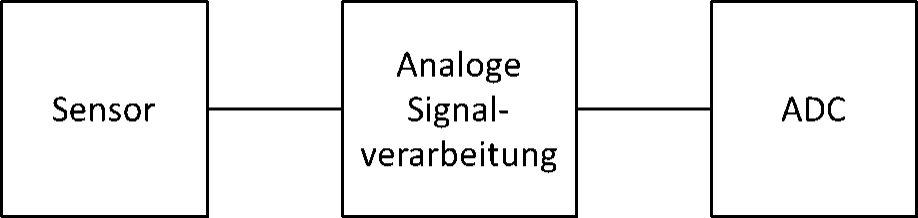
The output quantity of one block is the input quantity of the next block. If we only use the subscripts “EIN” (in) and “AUS” (out) for the signals, we get a naming problem with the signal names, because every function block of the measurement chain has input and output quantities. That is why the block name is added to the subscript. Since the term “analogue signal processing” is so long, I use the abbreviation “OP”, because in practice an operational amplifier (op-amp) is often installed in this part of the circuit. This is explained in more detail in the coming chapters. In this chapter, I use the following convention for naming the quantities:

I call the output voltage of a sensor US. Of course, US = UEIN,OP and UAUS,OP = UEIN,ADC, because these are identical voltages that are only named differently in different blocks. To describe the function of a block, we use its input and output names in each case.