Non-Oscillating Systems
Systems with non-oscillating PT2 behaviour have a damping greater than or equal to 1. A simple example is the series connection of two PT1 function blocks. These are not integrated into a control loop but are considered uncontrolled. In the following example, two PT1 blocks with τ = 1 and kP = 1 are connected in series:

The damping D has the value 1, so the system just does not oscillate. Because it does not oscillate, the value of the resonant angular frequency ω0 is irrelevant. There is a numerical value, but no oscillation. We can see in another way why the system cannot oscillate. To do this, we set s = jω and look at the denominator:
The denominator cannot become 0. Either only the real part becomes 0, for ω = 1 (green). Or only the imaginary part becomes 0, for ω = 0 (orange). There is no angular frequency ω at which the entire denominator becomes 0. That is why this system cannot oscillate. The step response of a system with non-oscillating PT2 behaviour looks like this:
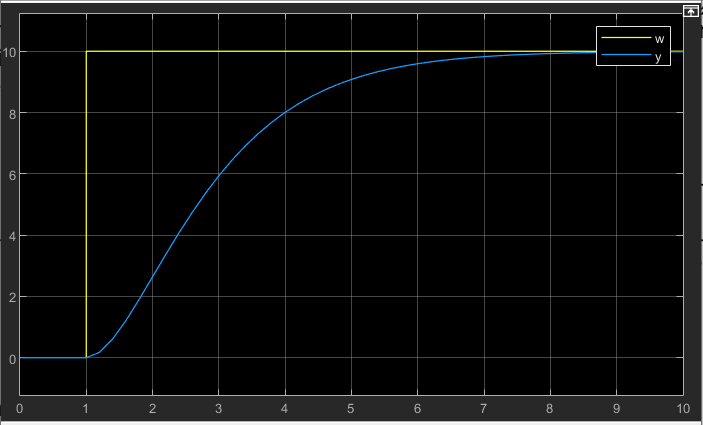
This step response looks very similar to that of a system with PT1 behaviour. PT1 behaviour and non-oscillating PT2 behaviour can only be distinguished in the step response by the fact that, with non-oscillating PT2 behaviour, the step response begins with a horizontal tangent (slope 0) directly after the step. There is no kink, but a smooth, S-shaped transition. With PT1 behaviour, by contrast, the step response rises immediately with its greatest slope.
The parameters of such systems are difficult to determine from the step response. One suitable method is the inflection tangent method, which obtains characteristic parameters from the step response from which the parameters of a PID controller can be determined directly. You will only understand this once you have read the chapter on controllers. For now, just take note of it.
In the inflection tangent method, you draw a tangent at the point of inflection of the step response. You can also hold a ruler against the screen as the tangent. From the graph you determine the two times tu and tg as shown in the following figure:
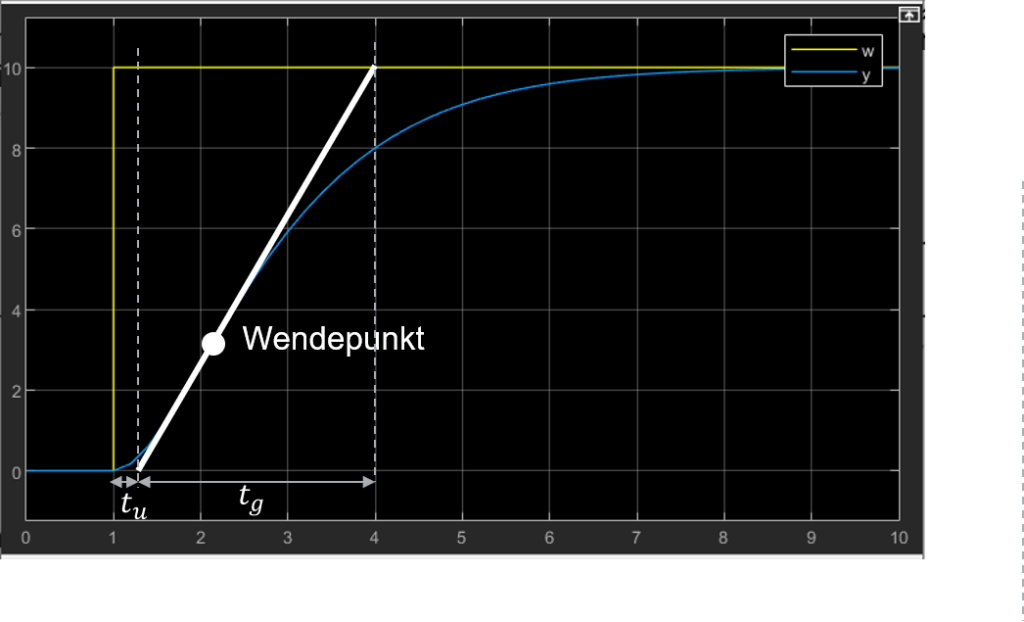
There are tables from which controller parameters derived from the two times can be taken directly. This is not explored further here. The method is very inaccurate, because hitting the point of inflection exactly is difficult. Slight shifts of the point of inflection quickly lead to large deviations in the times determined. Unfortunately, there is no really well-suited method for characterising such non-oscillating PT2 behaviour.
Non-oscillating PT2 behaviour is usually characterised by the parameters tu and tg.