Loads with Complex Impedances
Symmetrical load
So far we have loaded the fixed three-phase voltage of the grid with resistors. Three-phase voltage and three-phase current are then in phase. In practice, the grid is loaded by a complex impedance. As an example, let us consider the loading of the delta voltage U31 by a resistive-inductive load:
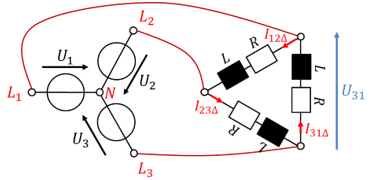
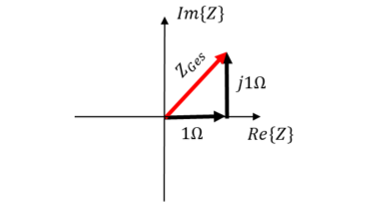
The goal is to calculate the current I31 through the load. For this we apply the complex form of Ohm’s law. For the RMS value of the voltage U31 in the grid:
Caution: this is not a general solution; it applies only to the chosen impedance. The current is different for every impedance. In general, the complex form of Ohm’s law applies, with which you can calculate currents in the grid. For this you use the (always identical) voltages of the grid defined in the previous chapter.
If the grid is loaded symmetrically (equally on all three phases), the following solution results for all three phases:
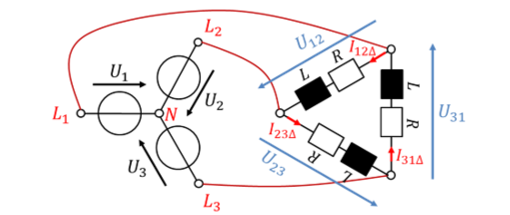
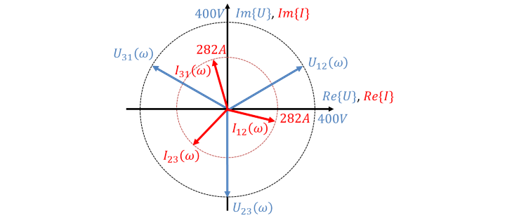
In the alternative solution below, we exploit the fact that the three-phase voltages in the grid are always phase-shifted by 120° relative to one another. So with a symmetrical load, the three-phase currents are also phase-shifted by 120° relative to one another.
In the phasor diagram, the same axes have been used for voltage and current. That is not good for phasors with different units. I chose this form of representation because it makes the symmetry in the shift of all three currents clear.
Asymmetrical loads
If the same impedance is connected as a load to all phases, we speak of a symmetrical load on the grid. The voltage sources of the power plant deliver a symmetrical current that is equal in all three phases.
Especially in the low-voltage grid at sockets, the load on the grid is asymmetrical. When you use a hairdryer, only the one of the three phases to which the socket is connected is loaded. The other phases then draw no current. With many households all drawing current from different phases, this roughly evens out. But because of the way the system works, the load is generally asymmetrical. The three-phase voltage remains symmetrical, because it is specified by the grid. Only the current can be asymmetrical.
With large consumers, efforts are made to keep the load on the grid symmetrical. If three-phase current from all three phases is used on symmetrical load impedances, a symmetrical current always results.
Asymmetrical current leads to a load on the generator shaft in the power plant that is not constant over one revolution, because not all electromagnets have the optimal force at the right time any more.
If the load in star connection is asymmetrical:
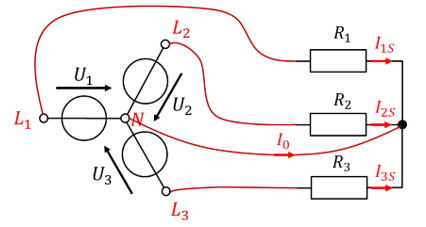
A compensating current flows through the N conductor. If a load in delta connection is asymmetrical:
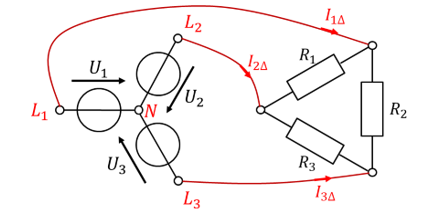
The node equation at the (unused) N terminal forces the currents from the source into the load to sum to 0A. With an asymmetrical load, the currents divide differently between the resistors.