Field Weakening
There are technical limits to voltage and current in electrical machines. In an electric car, electrical power is drawn from the battery. Its voltage depends on the state of charge. In 2020, the battery voltage is usually in the range [300V … 400V]. A freshly charged battery has a voltage of about 400V. When it is almost empty, the voltage is only about 300V.
From the DC voltage of the battery, the inverter generates an AC voltage for the electrical machine. The direction of the voltage – i.e. the electrical phase – can be set freely. The maximum possible peak value of the AC voltage depends on the DC voltage of the battery. You will learn how the AC voltage is generated in power electronics. If the machine needs more stator voltage than the battery can deliver, we can no longer control the machine optimally.
For this, let us look again at the voltages and currents in the d/q coordinate system:
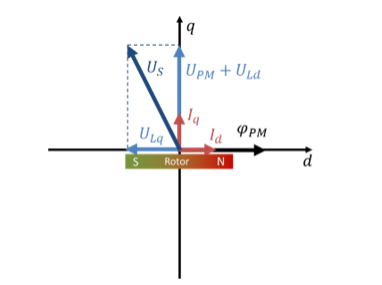
The graph shows the stator voltage as the sum of its d and q components. As a reminder: when the speed increases, the stator phasor becomes longer. When more torque is generated, the q-current is increased. This increases the magnitude of the (negative) d-voltage. In both cases the magnitude of the stator voltage increases. Above a certain combination of speed and torque, the battery can no longer provide the voltage. What can we do?
We could use a weaker permanent magnet or lower currents. This would reduce the stator voltage. Unfortunately, it would also reduce the maximum achievable torque. That gets us nowhere. There is a better solution:
If we impress a negative d-current, the resulting voltage acts in the -q direction. At the inductor, the voltage leads the current by a factor of j, so the voltage is rotated by 90° anticlockwise relative to the current direction. The current direction -d then becomes the voltage direction -q. The following graph shows voltages and currents with negative d-current:

Again, please do not pay attention to the absolute lengths of the phasors, only to the effect of a negative d-current. The length of the total voltage phasor becomes smaller when negative d-current is used. This allows the speed range of a machine to be increased considerably. This effect is called “field weakening”. With negative d-current, the stator coils build up a magnetic field acting in the (-d) direction. It counteracts the rotor magnetic field. The fields are superimposed, so the total field in the d direction becomes smaller.