Adapting Voltages
The voltage provided by a battery or a power supply does not always match the needs of the load. The following chapters present two methods with which the source voltage can be changed. Care is taken that a constant voltage that can be loaded is always provided, even with a varying load current. The goal is a controllable or adjustable ideal voltage source.
LDO
An LDO (low-dropout regulator) is an integrated circuit (IC) with a variable input voltage and a fixed output voltage. An LDO always needs a higher input voltage, which it reduces to a lower output voltage. The input voltage can vary over a wide range. The output voltage is fixed.
So the battery voltage at the input of the LDO may vary – depending on load, SOC, battery type etc. It only has to be greater than the minimum input voltage specified in the LDO's data sheet. The output voltage has a fixed value, which is also specified in the data sheet. You therefore select an LDO by a suitable input voltage range and a suitable output voltage.
The dropout voltage describes the difference between the input voltage and the output voltage. Good LDOs already work with a dropout voltage of only a few 100 mV. With good LDOs, for example, you can generate an output voltage of 3.3 V from an input voltage of 3.5 V or more. Let us look at an example that we will work with throughout this chapter:
Four NiMH AA batteries are connected in series. Depending on the SOC, the output voltage of one battery lies between 1 V and 1.3 V. In series, the output voltage is [4 V … 5.2 V]. The microcontroller of the load needs a supply voltage of 3.3 V. The load has an overall (equivalent) resistance of R = 100 Ω. Depending on the SOC of the batteries, a dropout voltage of [0.7 V … 1.9 V] remains for the LDO.
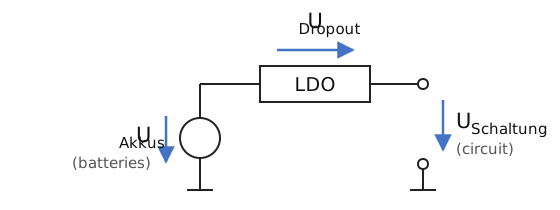
An LDO has a minimum dropout voltage, which generally depends on the output current. The dropout voltage must not be smaller than specified in the data sheet. It may, however, be larger. You just must not exceed the maximum input voltage of the LDO.
An LDO has a limited maximum power. The battery provides a voltage. The load behind the LDO draws current from the battery. Since the LDO is connected in series between battery and load, the entire load current flows through the LDO. The battery voltage is divided into the dropout voltage across the LDO and the voltage across the load. The following applies
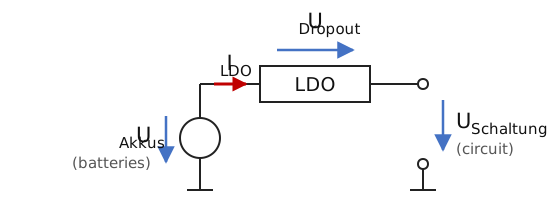
The power consumption of an LDO results from the current through the LDO multiplied by the dropout voltage. This power is converted completely into heat. As a result, the LDO may become very hot. The power at the LDO is therefore limited to a maximum value (data sheet). So you can either use the LDO with little current and a high input voltage, which then leads to a high dropout voltage. Or you use it with a high current and a less high input voltage.
An LDO is not an ideal voltage source. It has some real properties, but these are generally much better than those of the batteries. For example, its output voltage does not depend on the SOC. We are thus getting closer and closer to an ideal DC voltage source. The higher the dropout voltage, the better the real properties of the LDO generally become.
The LDO has an output resistance. As a result, an internal voltage decreases with the output current. However, this internal voltage is not the output voltage. As long as there is a sufficiently high dropout voltage, you do not notice this at the output, because the LDO compensates for this effect internally.
DC/DC converters
DC/DC converters generate a fixed, different output DC voltage from a variable input DC voltage. A major advantage is that the output voltage can also be greater than the input voltage. For example, with the four NiMH AA batteries at [4 V … 5.2 V], you can build a 12 V supply voltage for operational amplifiers using a DC/DC converter. So if your circuit needs more voltage than the battery can supply, you have three options: you can use a different battery, connect several batteries in series or use a DC/DC converter.
DC/DC converters are sometimes also used when the output voltage is (much) smaller than the input voltage and a lot of current flows. Let us look at an example. The following applies:
With this solution, most of the battery's energy is converted into heat in the LDO, and only a small part is used in the circuit. The efficiency of the solution indicates what percentage of the battery's power you actually use in the load. Especially in battery-powered circuits, the efficiency should be as high as possible, otherwise you need a battery that is far too large. Here, the following applies:
DC/DC converters provide their output voltage with high efficiency. This is typically between 70 % and 95 %, depending on the input and output voltage and on the load current. For the solution above, a DC/DC converter with an assumed efficiency of η = 80 % would be advantageous. The efficiency of the DC/DC converter is better than that of the LDO because it does not convert the excess voltage into heat in a component, but transforms the energy using fast-switching switches and energy stores (inductor, capacitor). That is why a much smaller current flows at the input than at the output.
You can calculate the input current – and thus the load on the batteries at the input – from the efficiency. The following applies:
With the LDO, 1 A is drawn from the batteries. A DC/DC converter draws only about a third of the current. For lowering the voltage, a DC/DC converter is particularly worthwhile when the input voltage is much greater than the output voltage and a high current flows. Compared with an LDO, a DC/DC converter then wastes relatively little power as heat.
DC/DC converters are relatively expensive and need relatively much space on a circuit board. That is why you do not find this solution in cheap and/or small circuits.
Since the output voltage of a DC/DC converter contains large high-frequency interference, a low-pass filter is almost always connected after it. Since an LDO acts as a low-pass filter, LDOs are often installed after DC/DC converters. These LDOs then only get as little dropout voltage as possible, otherwise the energy balance of the circuit becomes poor again.