Magnetically Conductive Material
When we use magnetically conductive material to generate fields for drives, we have an enormous lever for optimisation. With some materials, the magnetic conductivity reaches values of more than 100000. This means that, for the same current, a field 100000 times stronger can be built up than in air. Unfortunately, magnetically conductive material shows some unpleasant effects, which are described in this chapter.
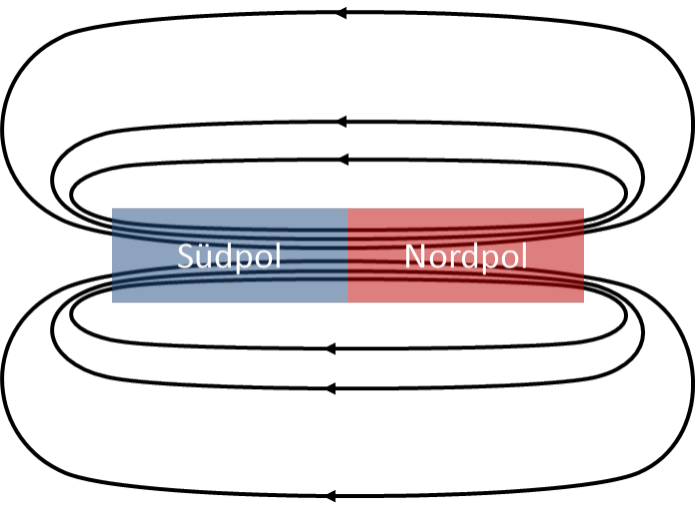
Magnetically conductive material consists of tiny magnetic dipoles. These are mini-magnets within the material that have the two magnetic poles, north pole and south pole. The material consists of tiny elementary magnets, also known as “Weiss domains”. Each of these has a magnetic north pole and a magnetic south pole. Each elementary magnet is surrounded by its own magnetic field.
An example of magnetically conductive material is iron. Initially, iron is not magnetic to the outside; you cannot exert a force with it. Inside, however, it consists of many elementary magnets, all randomly oriented in some direction.

Since the fields of all the elementary magnets are superimposed, they cancel each other out because of their random orientation. We now hold the piece of iron in a magnetic field. The elementary magnets in the iron then align themselves in the direction of the external field. It takes energy to rotate the elementary magnets, because they sit firmly in a structure. They only rotate against a mechanical resistance (friction). In general they do not rotate completely into the field direction.
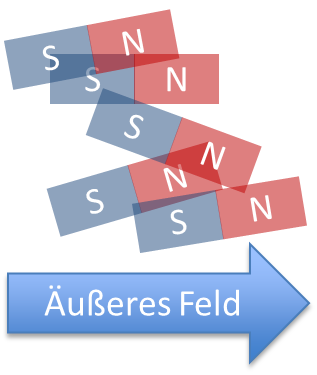
If we then remove the external magnetic field again, many of the elementary magnets remain aligned. They become mechanically interlocked in the new position, so that energy would again be needed to turn them back. Because of this alignment, the superposition of all the elementary fields produces a magnetic field of the piece of iron that is effective to the outside: the piece of iron has itself become a permanent magnet. It now generates a field itself, since the elementary magnets behave macroscopically like a single magnet.
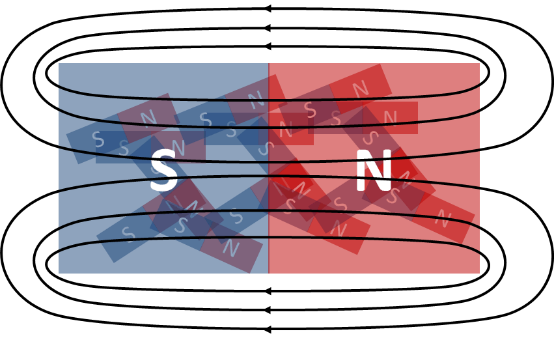
The total external magnetic field behaves exactly like that of an elementary magnet.
With the new magnet you can attract other pieces of iron. Since the piece of iron remains permanently magnetic, we speak of a permanent magnet. The field of an inductor exists only as long as current flows, so it is not a permanent field.
Material in the core of an inductor
To be able to concentrate the field of an inductor, we need magnetically conductive material in the inductor core. This ensures that the magnetic field exists almost only inside the inductor and hardly at all, pointlessly, in the space around the inductor. The field in the inductor thus also couples less strongly into other circuits and cables. This magnetically conductive material for field guidance consists of tiny permanent magnets, as described above.
The properties of modern, highly optimised magnetic cores show very large variations. The magnetic conductivity of cores from one batch can deviate by up to 50%. Magnetic conductivity is considerably more complex than shown here; it also depends on frequency and current.