Complex Phasors
For the following consideration, we need triangle mathematics. So here is a short refresher. In a right-angled triangle with the side lengths A, B and C, the following rules apply:
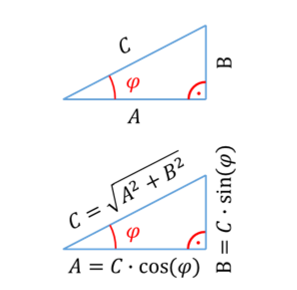
We can represent a complex number as a point in the complex plane. Alternatively, we can represent it as a pointer (arrow) from the origin of the coordinate system to the point. This arrow has a length and a direction. The direction is given as an angle. The zero point of the angle is the direction of the real axis (to the right). We calculate the length from the real part and the imaginary part. The arrow always forms a right-angled triangle with the real axis, in which we can calculate with sine and cosine. Let us look at the (green) complex number from the example above:
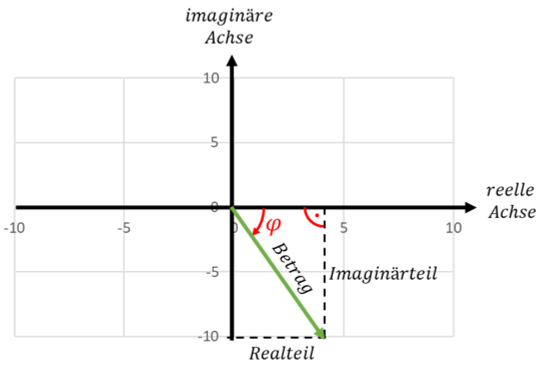
We abbreviate “imaginary part” as Im{…} and “real part” as Re{…}. The angle φ is drawn positive anticlockwise. So the angle φ = 45° points to the top right. In the example above, the angle is negative because, seen from the real axis, it is drawn clockwise.
We can describe a complex number mathematically in two ways: either we give the real part + j imaginary part. Then we walk the real part along the direction of the real axis and the imaginary part along the direction of the imaginary axis and thus reach the point in the complex plane. We call this form of mathematical description the component form (rectangular form).
Or we give the magnitude (pointer length) and the angle φ. Then we turn at the origin of the coordinate system by the angle φ anticlockwise and walk the length of the arrow in this direction. We call this form of mathematical description the exponential form. Both forms describe the same complex number, because they both end at the same point in the complex plane.
Rotation and length
We separate the rotation in the complex plane by the angle φ from the length of the pointer. We want to look at both effects independently of each other. The length should contain no rotation, and the rotation no length. Obtaining a pure rotation without a change in length is not trivial. For this, we need a rotation operator with length 1. Mathematically, the length corresponds to the magnitude. So we are looking for a general mathematical description of a pointer of length 1 that is rotated by the angle φ. In mathematics, such an operator is called a “unit vector”.
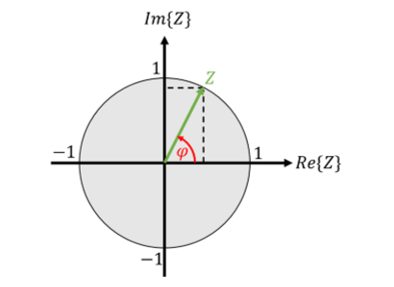
We consider a circle with radius 1 in the complex plane. The base of the pointer always lies at the origin of the coordinate system. A pointer that points from the centre of the circle to the circle always has length 1. The tip of the arrow can point anywhere on the circle. This always changes the angle φ, but never the length of the pointer. In vector calculus, this pointer corresponds to a unit vector. A unit vector always has length 1.
This pointer Z is a rotation operator. If we multiply Z by a constant factor, the factor describes the length and Z the direction of the pointer in the complex plane. We describe a pure rotation by φ without a change in length as cos(φ) + j ∙ sin(φ).
There is a brilliant property of complex numbers in the complex plane that allows an extremely simple mathematical description of a rotation by an angle φ. The following applies (without derivation):
So we rotate a vector by the angle φ by multiplying it by ejφ. We obtain the “pure” length of a vector without rotation information from the magnitude of the vector. We already looked at this further above. For the example of the number Z4 = 4 – j10, the following applies:
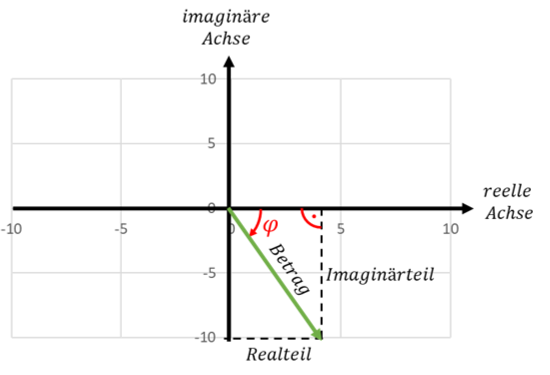
With the angle φ and the magnitude of a complex number, we can calculate the real part and the imaginary part (and vice versa):
You can see that both forms of representation describe the same vector.
As an example, we can now draw a vector with length 5 and direction 45°. To do this, we draw a circle with radius 5. Every vector that starts at the origin and ends on this circle has length 5. Then we give the vector the angle 45°. We start in the direction 0° to the right. Then we rotate anticlockwise by 45°, i.e. we let it point to the top right.
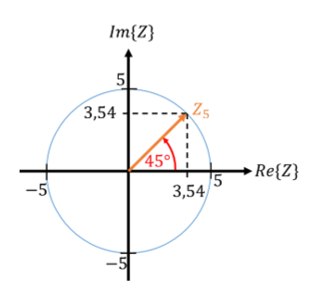
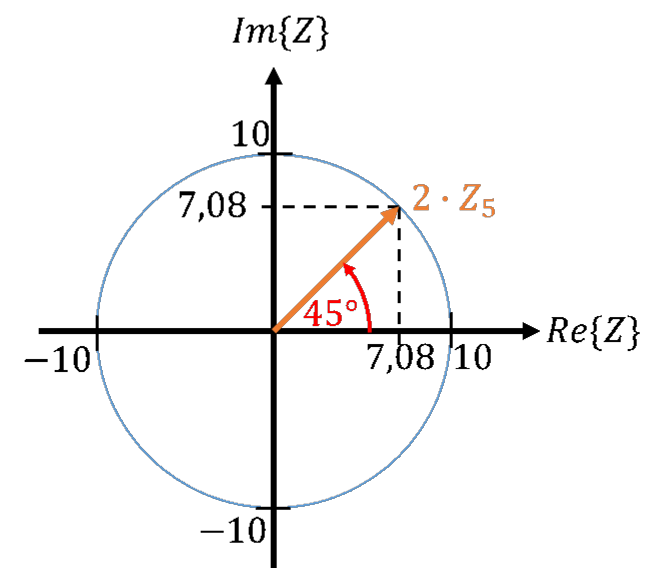
You can see that the real part and the imaginary part are always smaller than (or equal to) the vector length. We can now lengthen the vector by multiplying it by a constant value. We double its length by multiplying it by 2. This does not change its direction. The following applies:
We can also rotate the vector Z5 without lengthening it. To rotate it by 90°, we multiply it by the rotation operator ej90°. This rotation operator has length 1, so the multiplication does not change its length. The following applies:
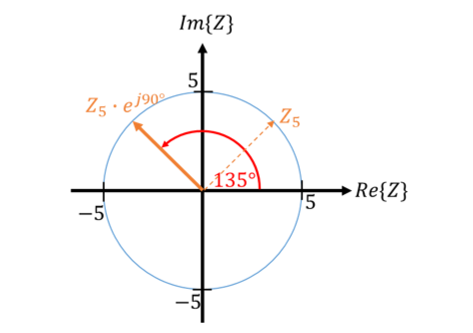
The rotation leaves the length unchanged. If you want to rotate clockwise, use a negative number in the exponent of the rotation operator.
You should now test whether you have understood the material by solving the following problem:
Problem
The vector Z6 = 3 ∙ ej225° is given. Draw the vector in the complex plane and calculate the real part and the imaginary part of the vector. Then multiply the vector by 5 ∙ ej45°, i.e. Z7 = 5 ∙ Z6 ∙ ej45°. What happens through this multiplication? Split the effect into a change in length and a rotation.
Arithmetic operations
We can add and subtract complex numbers in component form. This is not so easily possible in exponential form. The following applies:
Addition and subtraction work the same way in principle. We can also multiply and divide them. In component form, this looks as follows:
The solution is pretty ugly. It is often nicer to convert the numbers into exponential form first and then multiply them. Then the following applies:
Division is similar. It is easiest in exponential form:
In electrical engineering, to calculate voltages and currents we have to work out mesh equations, node equations, voltage dividers and current dividers. For this, we need the 4 basic arithmetic operations. For complex voltages and currents, you should choose the appropriate form of representation. Addition and subtraction are done in component form, and multiplication and division are easiest in exponential form.
Fortunately, your calculator can do all arithmetic operations in every form of representation. In this tutorial and in the solutions to the exercises, I will always choose the appropriate form of representation for the worked examples.