Modeling
A real technical system is described by mathematical equations. Equations help with calculating. But they do not help much with understanding. A block diagram is better suited for understanding. In a block diagram, a system is broken down into subsystems.
The block diagram consists of (function) blocks connected by signals. For simplicity, in this tutorial we only consider blocks with one input signal and one output signal. A block is described mathematically by its transfer function. The following applies:
Example of a function block: gearbox
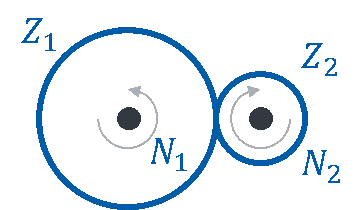
A gearbox has as its input quantity the rotational speed N1 at the input shaft (black). On the input shaft there is a gear (blue) with Z1 = 20 teeth. An output shaft has a smaller gear with Z2 = 10 teeth. It meshes with the first gear. The rotational speed N2 of the output shaft is the output of the gearbox.
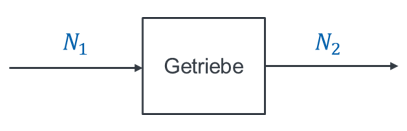
The gearbox is modelled as a block. The input of the block is the rotational speed N1. The output is the rotational speed N2. The gearbox is described by relating the output speed to the input speed. The block is drawn as a rectangle with its label in the middle. The signals are drawn as arrows with their names above them.
The rotational speeds are related to the number of teeth of the gears as follows:
This allows us to describe the transfer function independently of the values at the inputs and outputs:
This is important for modelling, because the rotational speeds change, but the number of teeth does not. The transfer function must be defined by internal quantities, independently of the current values of the input and output quantities.
With the transfer function you can calculate the output quantity directly from an input quantity. Rearranging the equation gives
So to model a block you need the names of the input and output quantities and the mathematical relationship between them.
Addition and subtraction
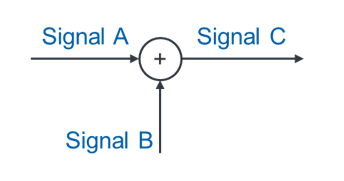
In a block diagram, signals have to be added and subtracted. These mathematical operations are modelled as follows:
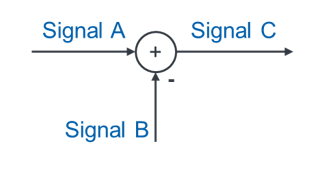
If subtraction is required, a minus sign is drawn at the signal to be subtracted.
Multiplication and division
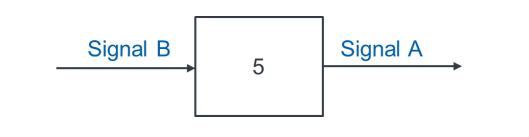
If we want to model the product of two quantities, we insert a block with a transfer function. The factor used for multiplication corresponds to the transfer function H of the block. We write the numerical value of the factor into the block. If, for example, signal B is to be multiplied by a factor of 5, you model it like this:
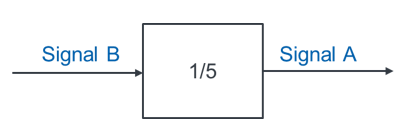
If we want to divide, we use a fraction as the factor H of the block. To divide signal B by 5, use the following model:
Example 1
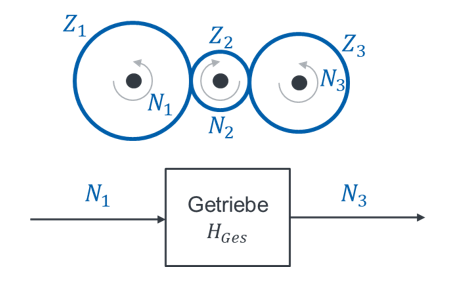
Let us look at a two-stage gearbox. Three gears are connected as follows:
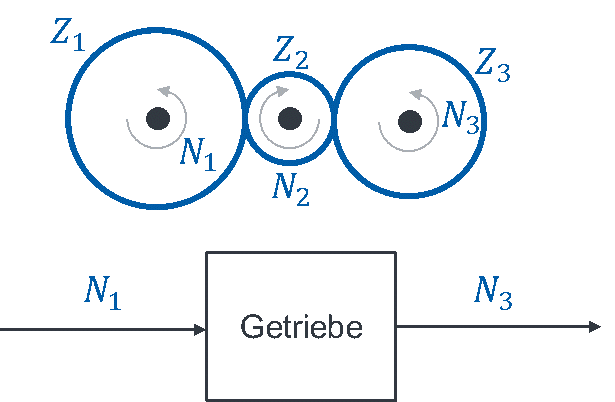
The input and output quantities must be defined in the problem statement; you cannot “recognise” them. The input quantity is the rotational speed N1 of the left gear. The output quantity of the gearbox is the rotational speed N3 of the right gear.
Let us calculate the transfer function of the function block “gearbox” (Getriebe). There is not one single correct solution here; the gearbox can be modelled in different ways. Let us begin by modelling each of the stages individually. We break the system down into subsystems and first consider only gears 1 and 2.
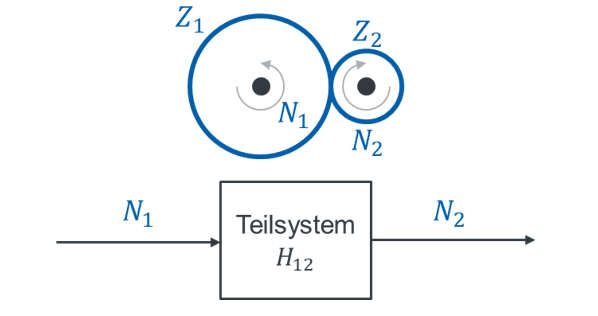
Intuitively, the solution H = 2 means that gear 2 turns twice as fast as gear 1.
Next we look at the subsystem of gear 2 and gear 3:
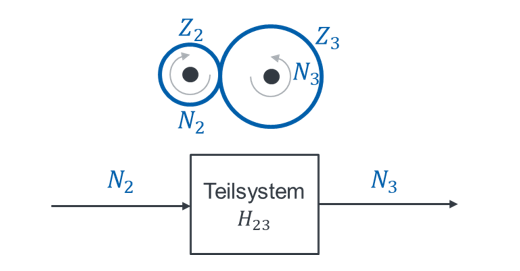
If we want to model the overall system, we bring both subsystems together. They are connected in series, because the output quantity of subsystem 1 is the input quantity of subsystem 2.
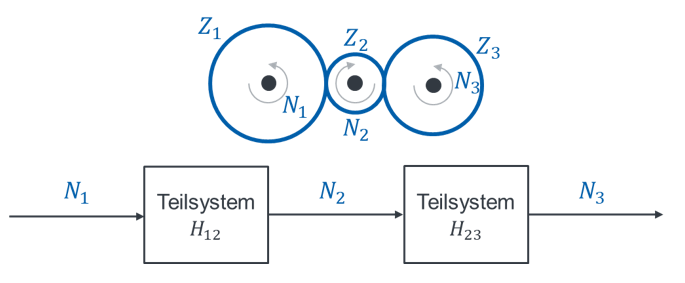
As lazy engineers, we are now done. In this case, however, we can simplify the model further. We can combine the transfer functions into one overall transfer function. This is easy here, because both transfer functions are factors:
Example 2
We look at a laser pointer mounted so that it can rotate, projecting a dot onto a screen. When the angle of the laser pointer is changed, the dot moves on the screen. The input quantity is the angle α (with which we intervene in the system) and the output quantity is the height h of the dot on the screen (the effect).
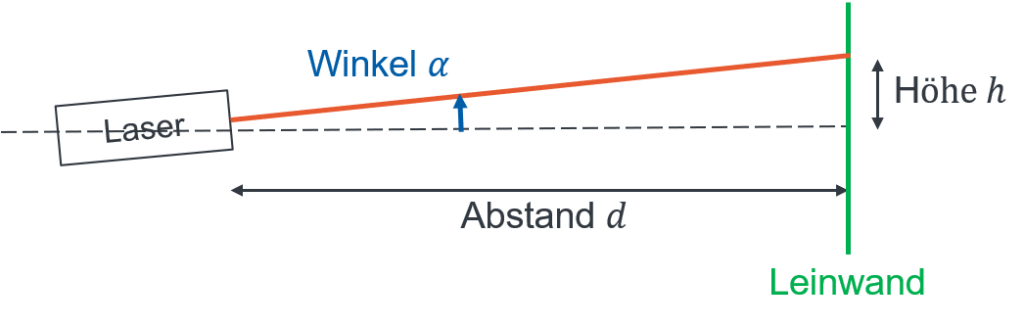
We always need some physics for modelling; otherwise we get no mathematical relationships. In control engineering exams and further exercises, the physics is always given. For the height h:
In this example we have obtained a formula that cannot simply be rearranged into output divided by input. The angle α is trapped inside the tangent; we cannot easily get it out. The arctangent does not help either – try it. That is why we use the “small-angle approximation” from mathematics. For small angles (in radians):
This allows us to complete the model. We draw the system in the block diagram as a block with its transfer function. We give the angle as the input quantity and the height as the output quantity.
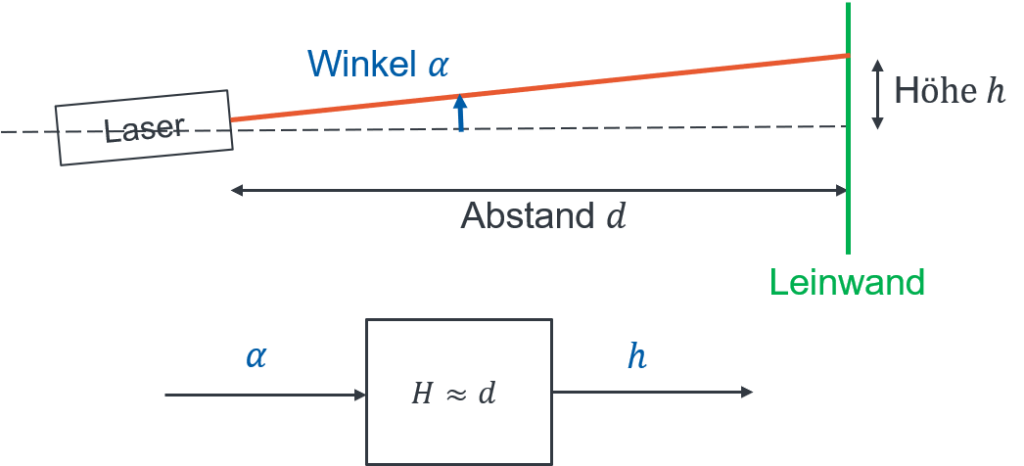
The result of the modelling is also intuitively plausible. If we increase the distance d, the height h increases for the same angle α.
Plausibility check
Important: the result of every model must be checked for plausibility. This means: vary the input and think about how the output should change. Then check by calculation whether the model works in the right direction. Bridges collapse and aircraft crash because of models that were not checked for plausibility. Checking plausibility is the most important skill of an engineer, especially when we look at the results of a model created by artificial intelligence.
Exact modelling
A model never represents reality exactly. That is why it is OK to approximate, as long as we are aware of it. In the set-up above, we cannot set the angle α with arbitrary precision, because nothing in the world rotates a laser pointer exactly and without tolerances. So we do not need perfect, error-free mathematics for the modelling either.
In control engineering, the aim is rather for the model to represent the behaviour of the system roughly. Creating exact models is so laborious that it is rarely done in practice. If exact modelling is required, you bring in a modelling expert or a control engineering specialist, not an ETR graduate with one semester of control engineering under their belt.