Connecting Batteries
A battery has a certain voltage and a certain maximum current. What can we do if that is not enough?
Batteries can be connected in series. For this, two or more batteries are connected conductively (e.g. via metal contacts). You typically find such a series connection in remote controls. The voltages of batteries connected in series add up to a total output voltage. In a series connection, the load current flows through all batteries. The weakest battery (with the lowest maximum current) therefore determines the maximum output current. The output resistance of the series connection equals the sum of the internal resistances of the batteries. So the internal resistance increases with the series connection.
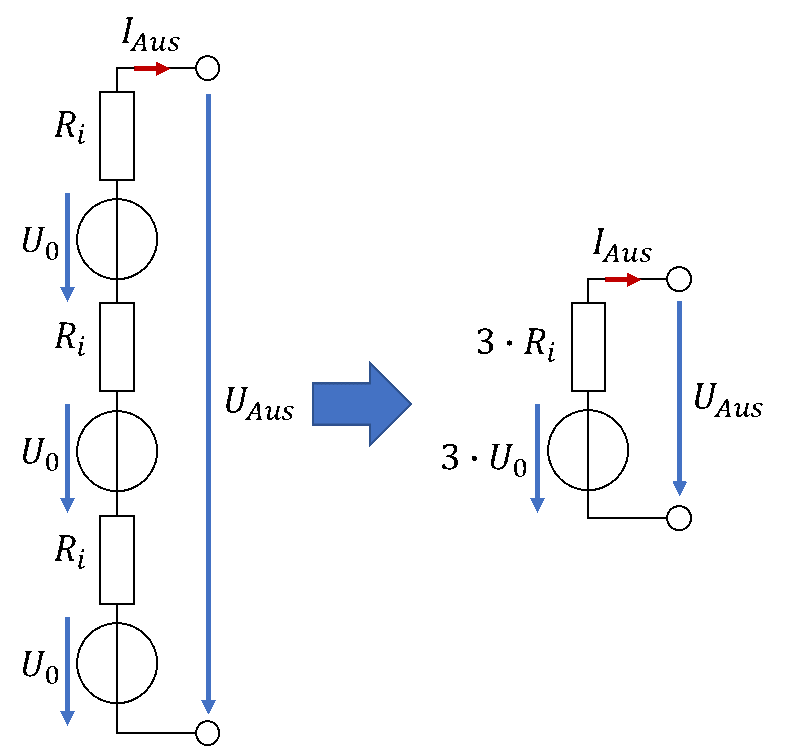
Manufacturers of battery packs solve the problem of the series connection for you. You can buy LiPo batteries with several cells in series. A 3s battery, for example, has three cells connected in series. This gives an output voltage of UPack = 3 ∙ UZelle (cell).
Batteries can be connected in parallel. The voltage at the output is then the same for all batteries. The output current is divided among all batteries. The battery with the lowest internal resistance must supply the most current, the one with the highest internal resistance the least. Unfortunately, the internal resistances of batteries are subject to variation. That is why care must be taken that individual batteries are not overloaded.
The biggest problem arises when the batteries connected in parallel do not all have exactly the same voltage – which is always the case in practice. If you simply connect them in parallel, an extremely high equalising current flows between the batteries, limited only by the internal resistances. That is why you must insert a resistor that limits the current when connecting them in parallel.
Example: connecting two AA batteries with typical voltage values of a full and an empty battery, as an extreme case:


With the series resistor, it takes some time until both batteries have the same voltage. The charge equalisation between the batteries takes longer the less equalising current flows. In return, both batteries survive being connected together. The series resistor can be removed as soon as both batteries have the same voltage.
For prototypes, you had better not connect batteries in parallel. Instead, use a battery with a higher output current. Such a battery may consist internally of cells connected in parallel at the factory. This is unproblematic because the cells there are matched to each other.