Op-Amp Supply
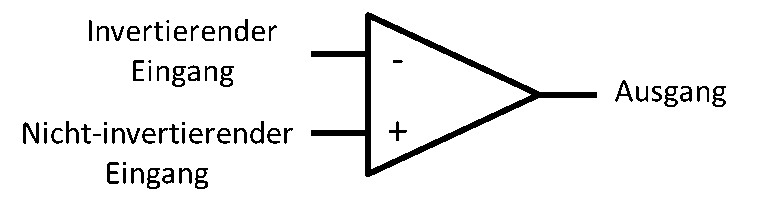
As the symbol for the operational amplifier in a circuit diagram, we use the triangle. There are 5 terminals for inputs and outputs:
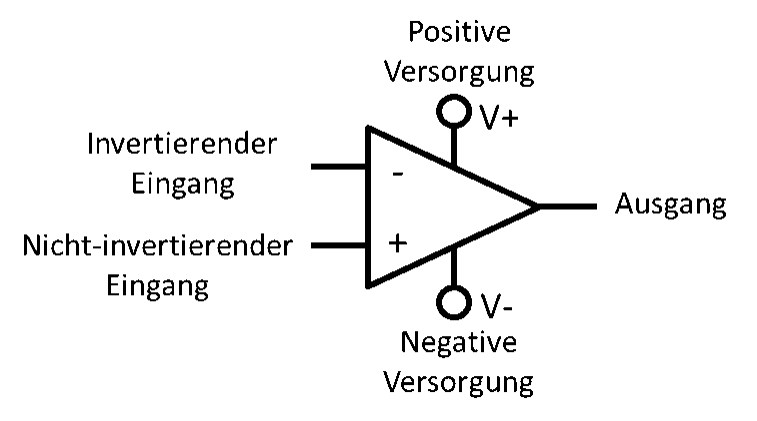
Amplifying a signal amplitude generally requires energy. Voltages are applied to the positive and the negative supply, through which the amplifier is supplied with energy. The value of these voltages limits the output voltage. The output voltage cannot be greater than the positive supply voltage and cannot be smaller than the negative supply voltage. That is why we like to choose high voltages, so that the op-amp covers a wide voltage range at its output.
It happens that the inputs are arranged differently in representations of op-amps. Sometimes the non-inverting (+) input is drawn at the top and the inverting (−) input at the bottom.
In the lab, +12 V is usually connected to the positive supply and −12 V to the negative supply. You generate the voltages with ideal voltage sources, which in practice can be implemented with batteries or laboratory power supplies, for example:
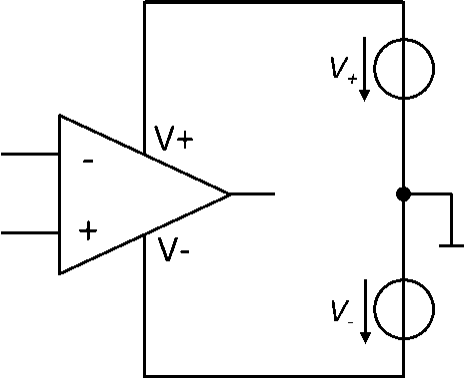
With a laboratory power supply, you can generate positive and negative voltages relative to ground. For a positive voltage, you plug the cable at ground potential into the black output of the power supply, which outputs the lower potential. The cable carrying the positive voltage is plugged into the red output of the power supply, which outputs the higher potential.
If you want to generate a negative voltage, simply swap the two terminals. The following figure shows how you can generate the ±20 V supply voltages of an op-amp from a laboratory power supply:
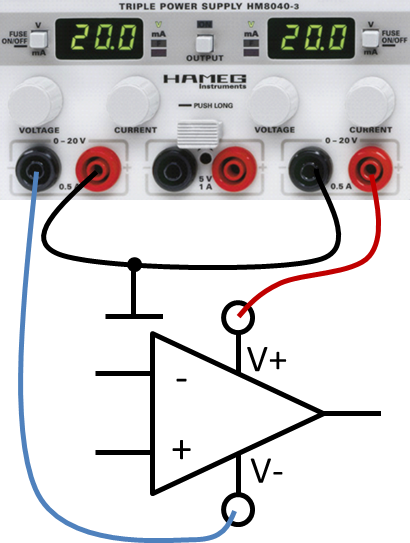
You do not need ground for supplying the circuit, but later for the signal amplification.
In the data sheet of an op-amp, the term “Supply Voltage” describes the maximum and minimum permissible voltages. Here you will also find the parameter “Maximum Output Voltage Swing”, which describes how high the output voltage can be at most.
In the lab course, you work with the op-amp “LM324” from Texas Instruments. You can find the data sheet under the following link. The supply voltage of this op-amp may be at most ±16 V.
The supply of an op-amp limits its output voltage, but it is often irrelevant for its function in the circuit. That is why the supply is often omitted in the circuit diagram and the op-amp symbol is reduced to a triangle with three terminals.