IGBTs
In circuits, IGBTs behave essentially like MOSFETs. Inside, however, they use a different technology. They combine the advantages of bipolar and MOSFET transistors. Their great advantage is their high voltage rating with moderate losses. For use in circuits there are only a few differences:
Modelling
The terminals of an IGBT are named differently from those of a MOSFET.
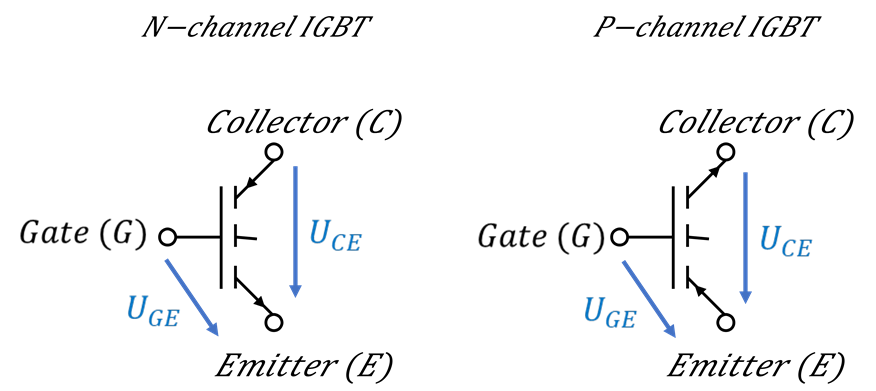
The voltage between gate and emitter UGE controls whether the IGBT is open or closed.
IGBTs have no parasitic PN diode between emitter and collector. In bridge circuits (4QS), however, these diodes are needed. That is why you have to add the diodes yourself. The diodes are always installed so that they work in parallel with the transistor and do not conduct the current of the input source to ground.
IGBT as a switch
In a MOSFET, the switching state determines the resistance between drain and source RDS. A closed IGBT behaves differently:
In an open IGBT, no current flows between emitter and collector. A closed IGBT behaves like two conducting diodes in series. Each of these high-current diodes has a forward voltage of about 0.8V … 1.5V. As with diodes, a “saturation voltage” drops across the IGBT, made up of a large fixed part and a small current-dependent part.
Because IGBTs have a high on-state voltage of about 1.5V … 3V, they are inferior to a MOSFET for many applications. Only at high currents and high voltages is the saturation voltage smaller than the product of current and on-resistance of a MOSFET. MOSFETs, however, cannot switch high voltages because their blocking voltage is low (a few 100V). IGBTs have a much higher blocking voltage of up to several 1000V.
The maximum switching frequency of IGBTs is lower than that of MOSFETs. They have longer switching times. Overall, the losses are higher than with MOSFETs.