Offset
An offset is a shift of a characteristic curve along the y-axis. If all values of the characteristic are too high or too low by a constant value, there is an offset. Mathematically, it is described by the parameter b in the straight-line equation y = m ∙ x + b. Here, y is the output signal and x the input signal. The offset is a negative number if all output values are too small.
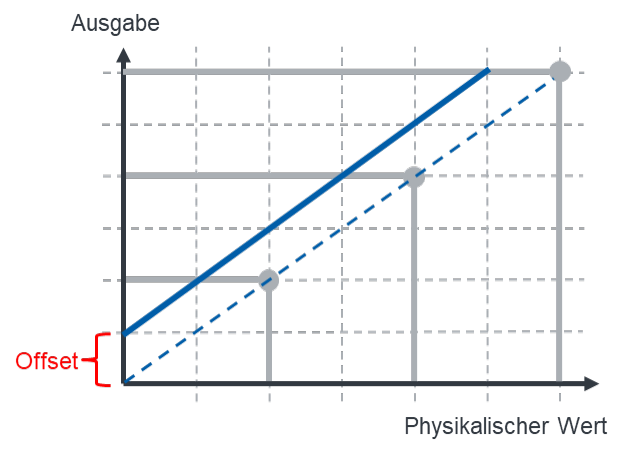
In the graph above – and in the following graphs – the desired proportional behaviour is shown as a dashed line and the real behaviour as a solid line.
The offset is determined by setting the physical quantity to 0 and reading the output of the system. With a scale, we place nothing on the weighing surface. If the scale then shows a value, this is the offset. To compensate for an offset, we subtract the offset from all output values that the system outputs. In digital signal processing, this is one line of code in the microcontroller:
Offset_Kompensierter_Wert = Unkompensierter_Wert – Offset
(offset-compensated value = uncompensated value – offset)