Kirchhoff’s Current Law
Current always flows in a loop. It flows from the top of a source through the circuit and back into the bottom of the source. It never flows through air, only along conductors. So current is guided purposefully through a circuit by conductors.
In the following example, the current from the voltage source U0 flows through the resistor R1. The current has no choice but to flow through this resistor; there is no alternative path out of the source. The current that flows into the resistor also flows out again. Illustrated with the water model, this means: the amount of water that flows into a pipe also flows out of the pipe again.
Depending on the pipe diameter and the gradient in the pipe, this amount of water can vary, but the same amount always flows in as flows out. So current is not lost in a component. Let us look at the following circuit diagram.
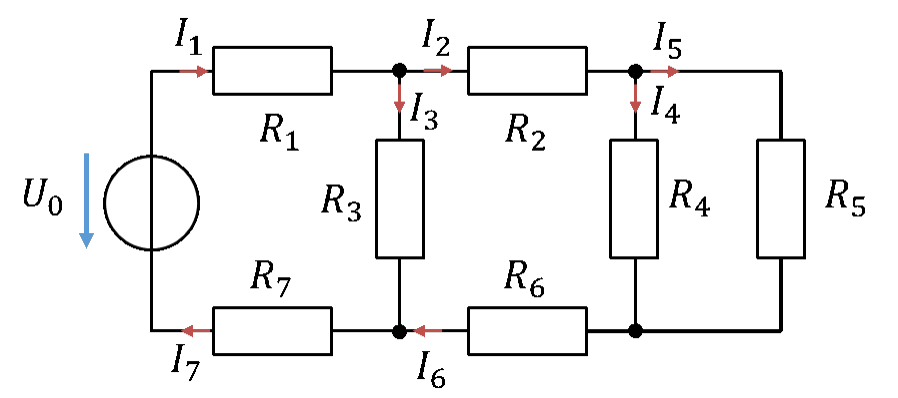
In this text we call the current through R1 IR1 or I1. To the right of R1 there is a first node.
Nodes are branch points for current where more than two conductors meet. At this node, the current I1 splits into the partial currents I2 and I3. They flow through the resistors R2 and R3. The magnitude of the partial currents is determined by the values of the resistors – more on this later.
At this node, the following must apply:
The water from pipe 1 splits into two further pipes 2 and 3. In general, Kirchhoff's current law (node rule) applies: the sum of the currents flowing into a node is equal to the sum of the currents flowing out of the node.
To the right of the resistor R2 there is another node, at which the current I2 splits into the partial currents I4 and I5. According to the node rule, the following applies here:
At the node below R4, exactly these currents flow together again. Therefore the following must apply to the current through the resistor R6:
The currents I2 and I6 are evidently equal. First the current I2 splits, and then the two split currents flow together again. The same applies to I1 and I7.
The current flows from the top of the source into the circuit, splits up there in some way, and at the end flows completely back into the bottom of the source. Current is never lost or flows into nowhere; it always flows from the source (in a loop) through the circuit and back to the source.