Résumé
Comportement I
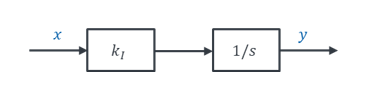
\[
\begin{gathered}
y(t) = k_I \cdot \int x(t)\,dt + y_0 \\[6pt]
\text{On pose } x(t) = 1 \text{ et } y_0 = 0\text{ : } y(t) = k_I \cdot t \\[6pt]
H(s) = \frac{1}{s} \cdot k_I
\end{gathered}
\]
Transformée de Laplace
\[
\begin{gathered}
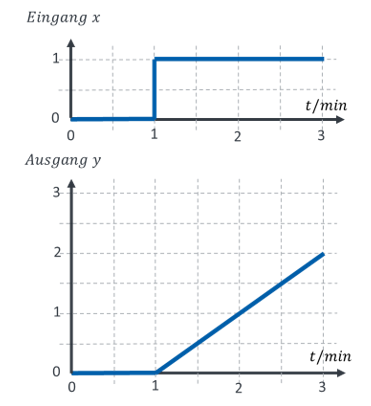
s = \sigma + j\omega \\[6pt]
\text{Comportement P : } y(s) = k_P \cdot x(s),\quad H(s) = k_P
\end{gathered}
\]
Comportement I dans la boucle de régulation

\[
\begin{gathered}
A = k_I \cdot \frac{1}{s} \\[6pt]
H_{\mathrm{FÜ}} = \frac{1}{1 + \frac{1}{k_I} \cdot s} \\[6pt]
H_{\mathrm{FÜ}} = \frac{1}{1 + \tau_{\mathrm{FÜ}} \cdot s} \text{ avec } \tau_{\mathrm{FÜ}} = \frac{1}{k_I} \\[6pt]
\text{Comportement I dans la boucle} \rightarrow \text{comportement PT1 du système régulé}
\end{gathered}
\]
Comportement PT1

\[
\begin{gathered}
H(s) = \frac{k_P}{1 + \tau s} \\[6pt]
u_{\mathrm{Aus}}(t) = u_{\mathrm{Ein}}(t) \left(1 - e^{-\frac{t}{\tau}}\right) \text{ avec } \tau = RC \\[6pt]
H(t) = \frac{u_{\mathrm{Aus}}(t)}{u_{\mathrm{Ein}}(t)} = 1 - e^{-\frac{t}{\tau}}
\end{gathered}
\]
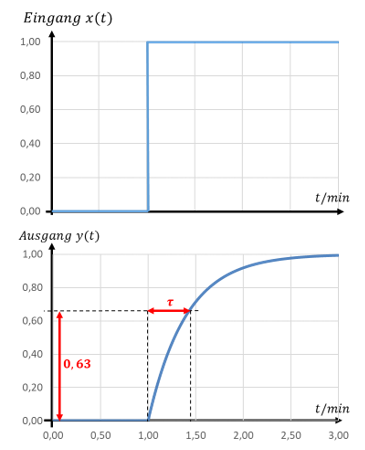
Exploitation d’une réponse indicielle :
\[
\begin{gathered}
\text{Régime établi : } s = 0;\quad \text{À l’instant de l’échelon : } s \rightarrow \infty \\[6pt]
H(s = 0) = k_P = \frac{y(t \rightarrow \infty)}{x(t \rightarrow \infty)} \\[6pt]
\tau = t_2 - t_1 \text{ avec } y(t_2) = 0{,}63 \cdot y(t \rightarrow \infty) \\[6pt]
t_1\text{ : instant de l’échelon du signal d’entrée}
\end{gathered}
\]
Comportement PT1 dans la boucle de régulation

\[
\begin{gathered}
A = \frac{k_P}{1 + \tau s} \\[6pt]
H_{\mathrm{FÜ}} = \frac{\frac{k_P}{1 + k_P}}{1 + \frac{\tau}{1 + k_P}\,s} = \frac{k_{P,\mathrm{FÜ}}}{1 + \tau_{\mathrm{FÜ}} \cdot s} \\[6pt]
k_{P,\mathrm{FÜ}} = \frac{k_P}{1 + k_P} \\[6pt]
\tau_{\mathrm{FÜ}} = \frac{\tau}{1 + k_P} \\[6pt]
\text{Comportement PT1 dans la boucle} \rightarrow \text{comportement PT1 du système régulé}
\end{gathered}
\]
Comportement D
\[
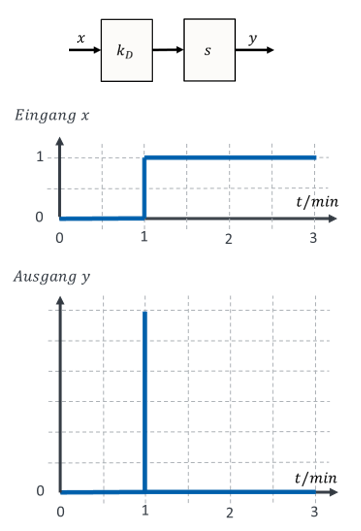
H_D = k_D \cdot s
\]
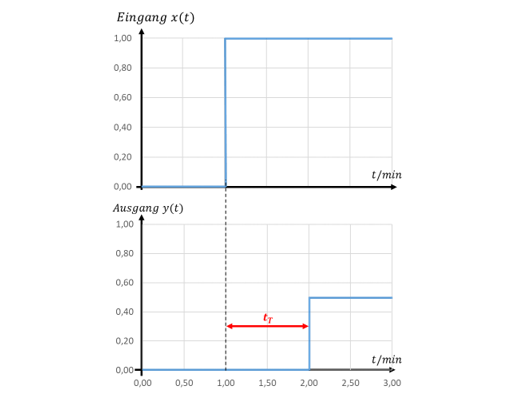
Temps mort
À l’instant t1, la grandeur d’entrée subit un échelon ; à l’instant t2, la grandeur de sortie montre sa première réaction.
\[
t_T = t_2 - t_1
\]
Exemple : système à comportement P avec kP = 0,5 et tT = 1 min :
Comportements P et I
\[
\begin{gathered}
\text{Comportement P} \cdot \text{I : } k_I' = k_I \cdot k_P \\[6pt]
\text{Comportement P+I : } H = \frac{y}{x} = k_P + k_I \cdot \frac{1}{s}
\end{gathered}
\]
De façon générale : un comportement décrit un type de comportement d’un bloc fonctionnel ou d’un système. Nous traitons de la même façon la description mathématique de tous les systèmes de même comportement ; ils ne diffèrent que par leurs paramètres caractéristiques, qui décrivent en quelque sorte l’intensité du comportement.